

20,000 children with rotten teeth missed out on agony-relieving op during Covid
20,000 children with rotten teeth missed out on agony-relieving op during Covid as number of extractions HALVED in first year of pandemic, dentists warn
Just 14,615 under-19s in England had teeth removed in first year of the pandemicFigure is down 20,000 in a year, leaving youngsters waiting for treatment in painDentists have called for details of backlog and extra cash to tackle it
<!–
<!–
<!–<!–
<!–
(function (src, d, tag){
var s = d.createElement(tag), prev = d.getElementsByTagName(tag)[0];
s.src = src;
prev.parentNode.insertBefore(s, prev);
}(“https://www.dailymail.co.uk/static/gunther/1.17.0/async_bundle–.js”, document, “script”));
<!–
DM.loadCSS(“https://www.dailymail.co.uk/static/gunther/gunther-2159/video_bundle–.css”);
<!–
Child tooth extractions fell by more than half in the first year in the pandemic, as dentists warn youngsters have been left in pain waiting for treatment.
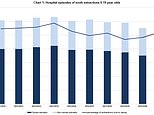
Official figures released today show just 14,645 under-19s in England had teeth removed due to tooth decay in the first year of the pandemic, 20,000 (58.4 per cent) fewer than one year earlier.
Health chiefs do not publish data on the number of children waiting in the queue for tooth removal.
But the British Dental Association (BDA) say the ‘collapse’ of the service does not ‘reflect any change in the demand’ for the operations, which take place in hospitals under general anaesthetic.
They have called for ‘full disclosure’ on how many youngsters are waiting for tooth extraction as well as a ‘properly funded plan’ to address the backlog.
Tens of thousands of children have been left waiting ‘in pain’ and facing difficulties learning, eating and sleeping for over one year, the BDA said.
The graph shows the number of tooth extractions performed on under-19s in England per year, split by how many were due to tooth decay (dark blue bars) or for other reasons (light blue bars). The figures show just 14,615 teeth were removed in the first year of the pandemic, down 20,575 (58.5 per cent) from 35,190 one year earlier
Figures from the Office for Health Improvement and Disparities (OHID) show there were 22,459 tooth extractions among under-19s in the year to March 2021.
Some 14,645 of these procedures — around two-thirds — were due to tooth decay.
The figure is 20,575 fewer (down 56.4 per cent) from the 35,190 procedures performed due to tooth decay in the year to March 2020.
This is despite a 0.4 per cent increase in the number of children in the population, health chiefs said.
Health chiefs estimate tooth extractions — the top cause of young children being admitted to hospital for over a decade — costs the NHS £21.8million per year, with decay-related removal alone costing £13.8million.
The OHID admitted the decline in tooth extractions is ‘likely due to the continued impact of the Covid outbreak on non-Covid related hospital episodes, rather than sudden reduction in need or demand’.
Over 12.5million NHS dental appointments for children have been lost in England since lockdown.
The OHID data shows there were treatment disparities across the country, with the North East seeing 285 tooth extractions per 100,000 under-19s, compared to just 72 per 100,000 in the West Midlands.
And tooth extractions among youngsters living in the poorest communities was three times higher compared to those living in richest areas.
The BDA warned oral health inequality is set to grow due to the scale of backlogs in primary care, ‘which limit the chance to catch problems early’.
Charlotte Waite, chair of the BDA’s England community dental services committee, said: ‘Tooth extractions among children have collapsed, but the level of demand hasn’t gone anywhere.
‘Covid has simply left tens of thousands in pain, potentially waiting years for treatment they desperately need.
‘Government has yet to offer real clarity on the scale of the backlog, or a credible plan to tackle it.’