

Covid UK: Wales to scrap self-isolation and masks on Monday
Wales to scrap Covid self-isolation and masks in shops and public transport on Monday… two months after England: Mark Drakeford ‘cautiously’ relaxes rules amid ‘unwelcome’ rise in cases
<!–
<!–
<!–<!–
<!–
(function (src, d, tag){
var s = d.createElement(tag), prev = d.getElementsByTagName(tag)[0];
s.src = src;
prev.parentNode.insertBefore(s, prev);
}(“https://www.dailymail.co.uk/static/gunther/1.17.0/async_bundle- -.js”, document, “script”));
<!–
DM.loadCSS(“https://www.dailymail.co.uk/static/gunther/gunther-2159/video_bundle- -.css”);
<!–
Welsh ruler Mark Drakeford is set to finally scrap compulsory masks in public settings and axe the legal requirement to self-isolate after a positive Covid test on Monday – two months after curbs in England were abandoned.
The First Minister will announce today that face covering restrictions will no longer be mandatory by law in shops and on public transport, but masks will remain necessary in health and social care for at least another three weeks due to rising case numbers.
Self-isolation will also cease to be compulsory, though the £500 self-isolation payment will continue to be paid until June.
And it will still be a legal requirement for businesses to continue to carry out risk assessments on their premises and put in place ‘reasonable measures’ to guard against Covid.
In a statement, Mr Drakeford said that Wales’ ‘cautious approach’ is due to the ‘unwelcome’ rise in virus cases. Adding that this ‘mirrored’ the position of the other UK nations, he said: ‘We have carefully considered the very latest scientific and medical evidence and we need to keep some legal protections in place for a little while longer, to help keep Wales safe.
‘Throughout the pandemic, we have taken a gradual and cautious approach as we have relaxed protections. We are firmly on the path towards leaving the emergency response to the pandemic behind us and learning to live with coronavirus safely.’
On Thursday, Wales’ case rate stood at 424.2 per 100,000 people over seven days, up from about 156 at the end of February.
Health Minister Eluned Morgan said most people would experience mild symptoms from BA.2, the Omicron sub-type, but it is still expected to drive an increase in cases and hospital admissions.
The Welsh Conservatives welcomed the end to self-isolation and mask wearing in shops and on public transport, but accused Labour of being ‘anti-business’.
Tory health spokesman Russell George said: ‘At a time when the Government should be doing all it can to boost jobs and productivity, is it right that businesses should continue to have fill out paperwork with little value? We need to trust businesses to do what is right to keep their staff and customers safe.’
His counterpart in Plaid Cymru, Rhun ap Iorwerth, said: ‘With a jump in cases, many will be concerned at the timing of the lifting of these measures.
‘There are issues around whether the end of self-isolation will signal the end of free lateral flow tests, so there remain areas on which Welsh government have to provide further clarity.’
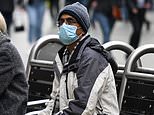
A man wearing a surgical face mask sits on a bench near social distancing signage on Queen Street in Cardiff
A woman wearing a face mask brings a tray of drinks to customers at Barkers Tea Rooms in High Street Arcade, Cardiff
The First Minister will announce that face covering restrictions will no longer be mandatory in shops and public transport, but masks will remain necessary in health and social care for at least another three weeks due to rising case numbers
The weekly swab survey by the Office for National Statistics has shown a rise in infections in the past couple of weeks. It suggested that 125,400 people in Wales had Covid in the week ending March 12 – up on the previous week’s estimate of 97,900.
In Scotland, Nicola Sturgeon sparked fury as she U-turned on plans to remove the country’s last remaining Covid laws by keeping mask rules in place.
The First Minister told Holyrood the face covering restrictions would be kept for at least two more weeks amid a spike in cases. She had been under pressure to bring Scotland into line with England by scrapping all remaining social restrictions, including laws demanding masks be worn indoors in public places.
Opponents had urged the First Minister not to backtrack but chief medical officer Sir Gregor Smith had advised a cautious approach amid concern over a recent rise in case numbers.
And Miss Sturgeon told MSPs in Edinburgh that keeping the mask mandate was ‘prudent’ and expected to lift the law before the Easter school holidays.
But Scottish Tory leader Douglas Ross slammed the decision, saying: ‘It’s true that cases rates are higher at the moment than any of us would like. But Covid cases were always going to rise as restrictions were eased.
‘We can’t get complacent with Covid but we have to move forward, we cannot stay stuck with Covid rules forever. That’s why it will be a blow for households and businesses that the First Minister has decided to keep the face mask rules in place.
‘Why won’t the First Minister trust the Scottish public to take the steps they think are right to protect themselves and their families? And why are we back to this “wait-and-see” approach again with no firm date to allow businesses and the public to plan ahead?’.
Other measures still in place, like forcing businesses to collect customer contact details, ceased as planned. The First Minister also confirmed plans to stop widespread Covid testing by the end of April.
The UK’S Covid outbreak is continuing to grow as official data showed daily cases and hospital admissions jumped by more than 10 per cent in a week and infection rates increased in all of England’s local authorities.
Hospitalisations are already at their highest ever level in Scotland and rising quickly in England, which combined with the growing infections has led health chiefs and scientists to call for some people to isolate if they have cold-like symptoms.
Dr Susan Hopkins, chief medical adviser at the UK Health Security Agency, urged Britons to wear masks in enclosed spaces and socialise outdoors again – just weeks after the restrictions were downgraded from law.
Professor Tim Spector, an epidemiologist at King’s College London, added: ‘We need to be telling people to self-isolate with cold-like symptoms and get a test if they can.’
Data from the ZOE study, which is based on swabs of more than 60,000 people and reports from 840,000 weekly contributors, today suggested there are 324,954 new symptomatic infections across the UK per day. The figure, which is the highest ever recorded by the study, suggests one in 19 people across the four nations currently have symptomatic Covid
Government dashboard data shows another 98,204 Covid-positive tests were logged in the last 24 hours across the UK, up by 9.5 per cent in a week and more than a third higher than a fortnight ago.
Cases have been trending upwards across the UK for nearly a month, with experts blaming the more transmissible Omicron subvariant BA.2, which is now dominant, and ditching Covid curbs. Meanwhile, 165 Britons died within 28 days of a positive test, climbing by a fifth in a the last seven days.
And 1,979 infected people were admitted to hospitals across the UK on Sunday, the latest date figures are available for, 11 per cent higher than one week earlier.
Separate data from the UK Health Security Agency (UKHSA) today showed Covid cases jumped in all of England’s 149 local authorities in the week to March 20 for the third week in a row.
The figures show the worst-hit areas are concentrated in the South West, with around 1.5 per cent of people testing positive in North Somerset, Cornwall and Isles of Scilly and Torbay.
Scotland is currently treating 2,322 Covid patients, the highest figure ever recorded in the country, breaching the peak of 1,571 during the Omicron wave and 2,053 during the 2020 winter peak. But its daily admissions appear to have peaked at 223 last week, in a promising sign the outbreak is slowing down.
In England, there are now 13,602 patients with the disease in hospital, which is less than half of the peak in early 2021. But figures from NHS England show more than half are not primarily unwell with the virus, suggesting the rise is a reflection of higher infection rates in the community, rather than a surge in severe disease.
On the back of data showing rising admissions and infections, Dr Hopkins said the figures are ‘a reminder to us all that the pandemic is not over’.
She added: ‘Hospital admissions and cases of Covid have continued to rise and we can expect to see further increases before we start to see a decline.
‘Vaccination is the key to staying safe from serious illness and it’s vital that everyone gets all of their recommended doses.
‘Wearing a face covering in crowded or enclosed spaces, socialising outside where possible, and always observing good hand hygiene will also help to reduce the spread of Covid.
‘Anyone with symptoms or a positive tests should limit their contact with others as much as possible.’
Her comments echoing pre-Freedom Day rhetoric come just one month exactly since restrictions were eased and public messaging on Covid was downgraded, with Brits encouraged to live with the virus and choose to follow protocols themselves where sensible.