

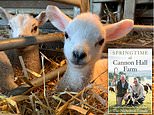
A lamb’s life gives them plenty to bleat about!
A lamb’s life gives them plenty to bleat about! The Nicholson Family reveal the constant attention adorable baby sheep need on their farm in a new nature book
South Yorkshire farmers The Nicholson Family reveal all about lambing The Channel 5 stars of Cannon Farm spend the months January to May lambing The book reveals how much work and effort it takes to look after the new arrivals
<!–
<!–
<!–<!–
<!–
(function (src, d, tag){
var s = d.createElement(tag), prev = d.getElementsByTagName(tag)[0];
s.src = src;
prev.parentNode.insertBefore(s, prev);
}(“https://www.dailymail.co.uk/static/gunther/1.17.0/async_bundle- -.js”, document, “script”));
<!–
DM.loadCSS(“https://www.dailymail.co.uk/static/gunther/gunther-2159/video_bundle- -.css”);
<!–
NATURE
SPRINGTIME AT CANNON HALL FARM
by The Nicholson Family (Ebury Spotlight £16.99, 288pp)
With food prices soaring and supplies looking precarious, it’s little wonder that television shows about farming are sprouting like chickweed.
There’s Jeremy Clarkson, floundering around amusingly in Clarkson’s Farm; dynamic mother-of-nine Amanda Owen in Our Yorkshire Farm; and the documentary series This Farming Life.
And then there is the Channel 5 series On The Farm. Its stars, the Nicholson clan — who can trace their farming lineage back to the 1600s — are the antithesis of Jeremy Clarkson.
South Yorkshire-based family The Nicholsons reveal what it is really like to work on a farm from January to May, a period dominated by lambing
You could never imagine them buying a flashy Lamborghini tractor which turns out to be too big for the farm shed, as Clarkson did.
The Nicholsons and Cannon Hall Farm in South Yorkshire have been appearing on television since 2018, but it was lockdown that really raised their profile. With the farm, its petting zoo and café all closed to visitors, the family — Roger, his wife Cynthia, and their three sons Richard, Robert and David — took to social media to livestream lambs being born, pigs being weaned and cows’ hooves being trimmed. In the middle of the pandemic, it made for strangely compelling and uplifting viewing.
Now here comes the book: an account of life on their farm from January to May, a period that is dominated by lambing. While pigs usually give birth with minimal effort — ‘one grunt and a piglet pops out’ — sheep have a much tougher time of it.
Ewes are given an ultrasound halfway through their pregnancy and their wool is marked according to how many lambs they’re expecting.
It turns out that those adorable young lambs that we see gambolling in the fields need constant attention
Ewes can only feed two lambs at a time so if they have triplets, farmers will use a form of subterfuge called ‘wet adoption’ (don’t ask, it’s quite gory) to try to persuade a ewe with a single baby that the other lamb is also hers.
If that fails, it will need to be laboriously bottle-fed for weeks.
Yes, it turns out that those adorable young lambs that we see gambolling in the fields need constant attention. They have to be vaccinated and wormed, the mucky bits of their coats need to be cut away — a process known as ‘dagging’ — and farmers have to keep a constant look out for fly infestation. A sheep which is infected by maggots can die within 24 hours.
SPRINGTIME AT CANNON HALL FARM by The Nicholson Family (Ebury Spotlight £16.99, 288pp)
Although the book is relentlessly upbeat about farming — you’d never know most of the farm’s lambs and piglets are destined to end up on our tables, since the word ‘abattoir’ is never mentioned — it does show what a truly tough job farming is.
In the 1960s, a farmer with 20 milking cows could just about make a living, but nowadays they would need around 400.
And sadly, as farms get bigger, much-loved traditional features like hedgerows and drystone walls are disappearing.
The Nicholsons have thrived because theirs is not only a traditional farm but also a major visitor attraction, complete with a reptile house, an adventure playground and a gift shop, and their staff includes marketing experts and retail strategists.
It’s a sign of how customer-focused they are that some of the sheep are mated in early autumn, weeks earlier than usual, to ensure there will be newborn lambs for families to coo over during the February half-term holiday.
Judging by this account, farmers have every reason to be permanently grumpy since they are always on high alert for the next disaster — disease, pests, droughts or floods — yet despite this it’s an easy, cheerful and rather informative read.
Farming may sound exhausting and unbearably stressful to townies like me, but according to youngest son David, ‘it’s the best job in the world’