

Biden will deploy 3,000 TROOPS to Eastern Europe in major show of force against Putin
Biden insists he has ALWAYS told Putin he’ll deploy troops to Eastern Europe and claims he’s being ‘aggressive’: Moscow tears into Joe’s ‘destructive step’ of sending in 3,000 soldiers as Ukraine crisis escalates
Joe Biden his decision to deploy troops to Eastern Europe amidst rising tensions is ‘totally consistent’ with what he has communicated to Russian President Vladimir Putin ‘As long as he’s acting aggressively, we are going to make sure we reassure our NATO allies in Eastern Europe that we’re there and Article 5 is a sacred obligation,’ he told reporters at the White House on Wednesday Biden approved deployment of 3,000 American troops to Eastern Europe ‘in the coming days’2,000 troops stationed in Fort Bragg, North Carolina will deploy to Poland and Germany this weekAnother 1,000 troops part of a Germany-based infantry Stryker squadron will reposition to Romania at NATO’s closest flank to RussiaRussia accused the U.S. of taking ‘destructive steps’ in moving troops to the region Republicans are warning Biden against another Afghanistan-type situations with a 20-year conflictLetters sent by US and NATO to Vladimir Putin offering to deescalate Ukraine crisis leaked by Spanish media Missives, which both sides refuse to confirm are genuine, show Putin was offered a deal to keep missiles out of Ukraine and renegotiate Cold War-era weapons treaties in return for withdrawing his troopsPutin is also warned that deploying more troops to the region will force NATO to strengthen its own forcesLetters leaked as satellite images revealed increased Russian troop activity in regions bordering Ukraine
<!–
<!–
<!–<!–
<!–
(function (src, d, tag){
var s = d.createElement(tag), prev = d.getElementsByTagName(tag)[0];
s.src = src;
prev.parentNode.insertBefore(s, prev);
}(“https://www.dailymail.co.uk/static/gunther/1.17.0/async_bundle–.js”, document, “script”));
<!–
DM.loadCSS(“https://www.dailymail.co.uk/static/gunther/gunther-2159/video_bundle–.css”);
<!–
Joe Biden says his decision to deploy troops to Eastern Europe amidst rising tensions is ‘totally consistent’ with what he has communicated to Russian President Vladimir Putin as Moscow accuses the U.S. president of taking ‘destructive steps.’
‘As long as he’s acting aggressively, we are going to make sure we reassure our NATO allies in Eastern Europe that we’re there and Article 5 is a sacred obligation,’ he told reporters at the White House on Wednesday.
The Pentagon revealed Wednesday that President Biden approved deployment of 3,000 American troops to Eastern Europe ‘in the coming days’ as the world watches Russia move closer to invading Ukraine.
Russian Deputy Foreign Minister Alexander Grushko told Russian news agency Interfax that the U.S. moves are ‘not substantiated by anyone’ and are ‘destructive steps which increase military tension and reduce scope for political decisions.’
Defense Department spokesman John Kirby detailed on Wednesday that 2,000 troops stationed in Fort Bragg, North Carolina will deploy to Poland and Germany this week. The majority of this group – around 1,700 troops – will come from the 82nd Airborne Division’s infantry brigade combat team and will go to Poland.
Just a few hundred – the remaining approximately 300 – will deploy from the 18th Airborne Corps to create a joint task force capable headquarters to provide mission command in Germany.
Another 1,000 troops part of a Germany-based infantry Stryker squadron will reposition to Romania at the North Atlantic Treaty Organization’s (NATO) closest flank to Russia. They will add to the 900 U.S. forces already in Romania
Kirby says France also intends to send troops to Romania.
The movements come as the west waits to see if Moscow will invade Ukraine after moving at least 130,000 troops to its border. Russian President Vladimir Putin has repeatedly claimed he does not intend to attack Ukraine.
Kirby assured reporters during his Wednesday briefing of the latest deployments: ‘These are not permanent moves. They respond to current conditions. We will adjust our posture as those conditions evolve.’
‘We do not believe conflict is inevitable,’ he assured
President Biden put 8,500 troops on heightened alert last month in preparation for movement to Eastern Europe to help bolster the region against threats from Russia should NATO activate its response force.
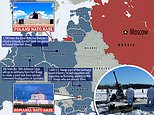
The US suggested in letters that Russian inspectors can gain access to NATO bases in Romania and Poland (pictured above) to guarantee that no Tomahawk missiles are being stationed there. Comes as Pentagon announces 2,000 troops in the U.S. will deploy to Poland and Germany and another 1,000 will head to Romania from their base in Germany
Biden told reporters Wednesday that his decision to deploy troops to Eastern Europe amidst rising tensions is ‘totally consistent’ with what he has communicated to Russian President Vladimir Putin ever since they started building a troop presence at the border with Ukraine. Biden speaks at an event held to ‘reignite the Cancer Moonshot’ at the White House February 2, 2022
Over the weekend, the U.S. sent another shipment of military aide to Ukraine. Pictured: Airmen from the 436th Aerial Port Squadron load ammunition, weapons and other equipment at Dover Air Force Base, Delaware on January 30
The shipment full of tons of military aid was loaded on Saturday and bound for Kiev as part of a foreign military sales mission
Since 2014, the U.S. has committed more than $5.4 billion in assistance to Ukraine. Pictured are pallets of a shipment of ammunition, weapons and other equipment bound for Ukraine as Russia built up troops at the border
U.S. soldiers take part in a training exercise with NATO forces in Latvia after Biden announced the troop deployment
Defense Department Spokesman John Kirby announced on Wednesday plans for deployment and movement of 3,000 troops in Europe. 2,000 troops stationed in Fort Bragg, North Carolina will deploy to Poland and Germany this week from the 82nd Airborne Division’s infantry brigade combat team and 18th Airborne Corps. Another 1,000 troops part of a Germany-based infantry Stryker squadron will reposition to Romania at the North Atlantic Treaty Organization’s (NATO) closest flank to Russia. They will add to the 900 U.S. forces already in Romania
‘They are trained and equipped for a variety of missions during this period of elevated risk,’ said a senior defense official told the Wall Street Journal, declining to to provide additional details on specific missions.
They added that the deployments also are ‘meant to deter the threat against the alliance.’
‘We are literally willing to put skin in the game.’
In addition to the 2,000-troop deployment and movement of forces already in Europe, the Pentagon has also ordered several thousand more troops be put on standby for potential deployment.
None of the troops are currently authorized to enter Ukraine.
As part of efforts to reassure the Kremlin about the threat it is facing, U.S. diplomats say they are willing to give Russia access to NATO bases in Poland and Romania to confirm that no Tomahawk cruise missiles are based there.
Biden signed off on the plan for troop movement after meeting with Defense Secretary Lloyd Austin and Chairman of the Joint Chiefs of Staff Army General Mark Milley on Tuesday.
The plan includes three different parts – the U.S. troop movement from Germany to Romania; the deployment from Fort Bragg of troops to Poland and Germany; and the continued standby of 8,500 other U.S.-based troops who were put on heightened alert late last month.
U.S. lawmakers are split on Biden’s decision to deploy, move and put troops on heightened alert in the midst of rising tensions in Europe.
Republican Senator Lindsey Graham is in favor of it.
‘I completely support the Biden Administration’s decision to send more U.S. troops to bolster NATO allies in the face of Russian aggression,’ the South Carolina senator tweeted on Wednesday. ‘It is imperative that NATO meet the moment and that we stand firmly against Putin’s efforts to divide the alliance.’
On the other hand, fellow Republican Senator Mike Braun from Indiana is against it.
‘I am strongly opposed to President Biden’s decision to send American troops to Eastern Europe,’ he tweeted along with an image of a longer statement on the matter.
He claims that the U.S. should not be getting engaged in conflict when other countries should ‘defend themselves’.
Senator Josh Hawley, a Trump ally from Missouri, said he supports sending assistance to Kiev to help Ukraine defend itself. He is, however, against the U.S.getting so involved in the potential of war with Russia.
The U.S. has already sent millions of military aid in at least six shipments to Kiev.
Washington and its NATO allies have offered to open talks with Moscow on arms control and trust-building measures to defuse the Ukraine stand-off, according to copies of letters sent to Vladimir Putin that leaked today.
The proposals, set out in missives by NATO and the United States last month in response to Russian demands, lay out in detail areas for future talks – including on nuclear weapons, the deployment of shot and medium-range missiles in Europe, military drills, cyber attacks, and space weapons.
Both letters clearly state that Ukraine will not be banned from joining NATO, and make no reference to Russia’s demand that all forces are withdrawn from ex-Soviet states.
The letters do not exclude the possibility of forces being scaled down, but make it clear that this would only happen if Russia makes reciprocal moves – for example by withdrawing forces from Ukraine, Georgia and Moldova.
They also note that, if Putin continues massing forces on Europe’s doorstep, then NATO and the US will be ‘forced’ to increase their own deployments in response.
A photo taken from a Russian Defense Ministry video shows Russian and Belarusian tanks drive during joint military drills at Brestsky firing range in Belarus on Wednesday, February 2, 2022
Airmen from the 436th Aerial Port Squadron load military aid and equipment bound for Kiev, Ukraine during a foreign military sales mission at Dover Air Force Base, Delaware on January 30, 2022
A view of the Osipovichi training ground near Mogilev, in Belarus, shows Russian mobile missile launchers (centre) parked up alongside tents housing their crews (top) as war games in the region get underway
Russian battle groups are shown camped out in tents at the Pogonovo Training Area, just south of the city of Voronezh, which sits around 100 miles north of the Ukraine border
Tents and surrounding ground chewed up by vehicle tracks are seen at a Russian base in Angarsky, Crimea, on Tuesday
Tents and armored vehicles are seen at Russia’s Opuk Training Area in occupied Crimea on Tuesday
Russian President Vladimir Putin, in a rare statement on the crisis Tuesday, said diplomacy can still resolve the crisis but the West must start taking Russian security concerns seriously. Putin is pictured Wednesday, February 2, 2022 after a ceremony in Moscow where he presented Russia’s highest state awards for distinguished achievements
Both NATO and Russia have refused to comment on the authenticity of the documents, which leaked to Spanish media. They emerged as satellite images showed Putin continuing to mass troops near Ukraine and in Crimea.
A NATO official refused to confirm the text, saying: ‘We never comment on alleged leaks.’ Kremlin spokesman Dmitry Peskov said Moscow was aware of the report but added: ‘We didn’t publish anything, and I don’t want to comment on this.’
President Vladimir Putin’s government has deployed a huge force of up to 130,000 troops backed by tanks and artillery near the Ukraine border and in Crimea, a Ukrainian region that Russia annexed in 2014.
The Kremlin has since demanded that NATO guarantee that Kiev never be allowed to join and that the alliance withdraw forces from eastern member states that were Soviet allies or republics during the Cold War.
Western allies have dismissed calls to slam shut NATO’s door, but the leaked letters call for ‘meaningful arms control discussions and dialogue with Russia on mutual transparency and confidence-building measures.’
‘No other partner has been offered a comparable relationship or a similar institutional framework,’ the allies said of the NATO-Russia council, in the letter released by El Pais.
‘Yet Russia has broken the trust at the core of our cooperation and challenged the fundamental principles of the global and Euro-Atlantic security architecture,’ it says.
The US document stresses: ‘We are ready to consider arrangements or agreements with Russia on issues of bilateral concern, to include written, signed instruments, to address our respective security concerns.’
It suggests renewing the US-Russian Strategic Stability Dialogue on arms control agreements to ‘limit ground-based intermediate and shorter-range missiles and their launchers’.
But it repeats Washington’s warning that Russia is already in breach of the now suspended 1987 Intermediate-Range Nuclear Forces Treaty, which the US withdrew from in 2019, accusing Moscow of deploying a banned type of missile.
And it warns: ‘Further Russian increases in force posture or further aggression against Ukraine will force the United States and our Allies to strengthen our defensive posture.’
The leak emerged after Putin accused the US of trying to draw Russia into a war in Ukraine as a pretext for imposing harsh sanctions on his country.
The Russian president charged Washington with using Ukraine as an ‘instrument’ to bully Russia and ‘contain’ its development, while ignoring legitimate security fears.
Putin, who has rarely spoken since the Ukraine standoff began in November, said on Tuesday that he hopes a diplomatic solution to the crisis can still be found.
Troop tents and armoured vehicles are pictured at Russia’s Yevpatoriya base in occupied Crimea on Tuesday
Tanks (centre, on top of raised earth mounds) are pictured on a firing range at Pogonovo, Russia, on January 26
A satellite picture shows Russian armoured forces massed at a base in Yelnya, around 150 miles from Ukraine, on January 19
Tanks and support vehicles are pictured in Russia’s Yelna region in a satellite image taken on January 19
America is trying to draw Russia into a war in Ukraine as an excuse to slap the country with sanctions, Putin has claimed (pictured, Ukraine’s territorial defence forces in training)
But, he added, that will only happen if the ‘interests and security of all parties, including Ukraine, European nations and Russia’ are respected.
Putin issued a rare statement on the crisis Tuesday, speaking after a meeting with Hungary’s Viktor Orban – a member of NATO – in Moscow.
He said the Kremlin is still studying written responses that Washington and NATO gave to his security demands, but said it is clear that most of Russia’s concerns are being ignored.
Putin argued that it’s possible to negotiate an end to the standoff if the interests of all parties, including Russia’s security concerns, are taken into account.
‘I hope that we will eventually find a solution, although we realize that it’s not going to be easy,’ he said.
Putin said the Western allies’ refusal to meet Russia’s demands violates their obligations on the integrity of security for all nations.
He warned that a Ukrainian accession to NATO could lead to a situation where Ukraine launches military action to reclaim control over Russian-annexed Crimea or areas controlled by Russia-backed separatists in the country’s east.
‘Imagine that Ukraine becomes a NATO member and launches those military operations,’ Putin said. ‘Should we fight NATO then? Has anyone thought about it?’
Russia annexed the Crimean Peninsula in 2014 following the ouster of the country’s Moscow-friendly president and later threw its weight behind rebels in Ukraine’s eastern industrial heartland, triggering a conflict that has killed over 14,000 people.
Putin charged that while the US airs concerns about Ukraine’s security, it is using the ex-Soviet country as an ‘instrument’ in its efforts to contain Russia.
He alleged that Washington may try to ‘draw us into a military conflict and force its allies in Europe to impose the tough sanctions the U.S. is talking about now.’
Another option would be to ‘draw Ukraine into NATO, deploy offensive weapons there’ and encourage Ukrainian nationalists to use force to reclaim the rebel-held east or Crimea, ‘drawing us into a military conflict.’
‘We need to find a way to ensure interests and security of all parties, including Ukraine, European nations and Russia,’ Putin said, emphasizing that the West needs to treat Russian proposals seriously to make progress.
He said French President Emmanuel Macron may soon visit Moscow as part of renewed diplomatic efforts following their call on Monday.
Boris Johnson speaks with Ukraine’s President Volodymyr Zelensky in Ukraine during a diplomatic visit on Tuesday
The UK has thrown its weight behind Ukraine since the crisis started, flying out anti-tank missiles and deploying extra forces to eastern Europe
Earlier this week, Russian foreign minister Sergei Lavrov sent letters to the U.S. and other Western counterparts pointing out obligations signed by all members of the Organization for Security and Cooperation in Europe.
Russia argues that NATO’s expansion eastward has hurt Russia’s security, violating the principle of ‘indivisibility of security’ endorsed by the OSCE in 1999 and 2010.
It says the U.S. and its allies have ignored the principle that the security of one nation should not be strengthened at the expense of others, while insisting on every nation’s right to choose alliances.
In his letter, which was released by the foreign ministry, Lavrov said ‘there must be security for all or there will be no security for anyone.’
In a separate call with US Secretary of State Antony Blinken, Lavrov warned that Moscow will not allow Washington to ‘hush up’ the issue.
Blinken, meanwhile, emphasized ‘the U.S. willingness, bilaterally and together with Allies and partners, to continue a substantive exchange with Russia on mutual security concerns.’
However, State Department spokesman Ned Price said Blinken was resolute in ‘the U.S. commitment to Ukraine’s sovereignty and territorial integrity, as well as the right of all countries to determine their own foreign policy and alliances.’
Blinken ‘urged immediate Russian de-escalation and the withdrawal of troops and equipment from Ukraine’s borders,’ Price said.
He reaffirmed that ‘further invasion of Ukraine would be met with swift and severe consequences and urged Russia to pursue a diplomatic path.’
A Ukrainian soldier is seen patrolling a trench near the frontlines with Russian-backed rebels
T-64 tanks covered by snow stand at the depot site at the Tank Repair Plant in Kharkiv, Ukraine
A bullet riddled effigy of Russian President Vladimir Putin is coated by fresh snow at a frontline position in the Luhansk region, eastern Ukraine
A Belgian Air Force F-16 is seen at Amari Air Base, Estonia, after Russian aircraft flew into the country’s airspace on Tuesday
Senior State Department officials described the call as professional and ‘fairly candid,’ noting that if Russia wanted to prove it isn’t going to invade Ukraine, it should withdraw its troops from the border and neighboring Belarus.
Shortly after speaking to Lavrov, Blinken convened a conference call with the secretary general of NATO, the EU foreign policy chief and the chairman-in-office of the OSCE as part of efforts to ensure that the allies are engaged in any further contacts with Russia.
Speaking to reporters at the United Nations, Russia’s U.N. ambassador, Vassily Nebenzia, said the U.S. statement about its readiness for dialogue ‘doesn’t correlate’ with Washington sending planeloads of military equipment to Ukraine.
‘I don’t know why the U.S. is escalating tensions and at the same time accusing Russia,’ he said.
British Prime Minister Boris Johnson visited Kyiv for scheduled talks with Ukrainian President Volodymyr Zelenskyy.
Johnson said the U.K. has a package of measures including sanctions ready to go ‘the moment the first Russian toecap crosses further into Ukrainian territory.’
‘It is vital that Russia steps back and chooses a path of diplomacy, and I believe that is still possible,’ Johnson said. ‘We are keen to engage in dialogue, of course we are. But we have the sanctions ready.’
He said he would have a call with Putin on Wednesday, noting that the Russian leader was trying to ‘impose a new Yalta, new zones of influence’ in a reference to the 1945 deal between the allied powers.
‘And it would not just be Ukraine that was drawn back into the Russian sphere of influence,’ Johnson added.
In other developments, Biden was expected to nominate career foreign service officer Bridget Brink to assume the long-vacant diplomatic post of American ambassador to Ukraine, according to a U.S. official familiar with the decision.
Brink currently serves as the ambassador to Slovakia.