

Six new cases of Omicron detected in Scotland as UK labs probe 225 ‘possible’ samples
Six new cases of Omicron in Scotland and up to 225 across UK: Every adult in Britain offered third Covid jab as experts call for compulsory masks in classrooms and pubs with Sajid Javid to hold update TODAY – with next two weeks ‘crucial to save Christmas’
Every adult in Britain is to be offered a third jab within weeks to combat the spread of the Omicron variantCovid restrictions including travel bans, testing and facemasks will be necessary to fight new Covid strain Contact tracers have hunted for church-goers and KFC visitors linked to outbreaks in Essex and Nottingham Sajid Javid said the UK would avoid another lockdown for the time being despite a new super-strain outbreak Almost 18 million people have so far had booster jabs, which until now have been restricted to over-40s
<!–
<!–
<!–<!–
<!–
(function (src, d, tag){
var s = d.createElement(tag), prev = d.getElementsByTagName(tag)[0];
s.src = src;
prev.parentNode.insertBefore(s, prev);
}(“https://www.dailymail.co.uk/static/gunther/1.17.0/async_bundle–.js”, document, “script”));
<!–
DM.loadCSS(“https://www.dailymail.co.uk/static/gunther/gunther-2159/video_bundle–.css”);
<!–
Six cases of the Omicron variant were confirmed in Scotland today and UK labs are probing 225 more ‘possible’ infections— as experts warn they need at least two weeks to work out what impact the mutant strain will have on Christmas.
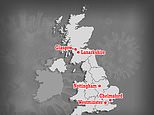
Scottish health officials said four of the infections were spotted in Lanarkshire, and the other two were in the Greater Glasgow and Clyde area. It means there are now nine official cases in the UK, after three were detected in England over the weekend.
Scotland’s Deputy First Minister said some of Scotland’s cases were not linked to travel to southern Africa, suggesting the variant is already spreading in the community. Across the country, Government labs are examining 75 ‘probable’ cases of Omicron and up to 150 ‘possible’ cases.
Britain’s Covid vaccine advisory panel is expected to extend the booster vaccine programme to all over-18s today to give the country another line of defence against the variant, feared to be more transmissible and vaccine-resistant than Delta.
Ministers have already reintroduced face mask mandates in communal areas in schools, such as corridors, and on public transport and in shops.
But experts have called for the policy to be extended to classrooms, pubs and restaurants, with SAGE scientist Professor Sir Mark Walport saying it ‘made sense’ because the virus does not distinguish between indoor settings.
Health Secretary Sajid Javid will today chair an urgent meeting with G7 health leaders in London to thrash out an international strategy to deal with the strain, which has now been spotted in six European countries and three continents.
But in a promising sign, health minister Edward Argar said Britons could still look forward to a ‘normal’ Christmas and that he does not see any further restrictions being imposed over the festive period.
Experts say at least two weeks are needed to understand whether the variant is more likely to cause hospitalisation because this is how long it takes for someone who has caught the virus to develop severe symptoms.
So far, South Africa says it has not seen a single hospital admission or death from the new variant, with doctors in Johannesburg reporting patients with much milder symptoms than with the Delta strain.
It has raised hopes among some scientists that the new strain could be more akin to a common cold, and speed up the end of the pandemic.
Almost 18 million people in Britain have so far had booster jabs, which until now have been restricted to over-40s, frontline medics and those with health issues. But now 12.8 million Britons in the 18 to 39 age group will be invited for a third shot.
The vaccine rollout may be accelerated by shrinking the gap between second and third doses from six months to five. The Joint Committee on Vaccination and Immunisation (JCVI) is also considering whether to offer second doses to 12 to 15-year-olds, who currently only get one jab.
Some six Covid cases have bene detected in Scotland, taking the UK’s total infections to nine. The other three were detected in Brentwood, pictured, Westminster and Nottingham. Up to 225 ‘possible’ cases are also being investigated
Between November 11 and November 26, there were 48 direct flights from Cape Town and Johannesburg to London Heathrow. During this period, there were two British Airways flights and one Virgin Atlantic flight per day
All flights from South Africa, Botswana, Lesotho, Eswatini, Zimbabwe and Namibia were banned by Mr Javid
As the ninth case of the Omicron variant was confirmed in Britain:
The head of the UK Health Security Agency admitted it was ‘very likely’ that further cases of the new strain would emerge; Families were told to plan for Christmas ‘as normal’ as ministers rejected calls to bring back more lockdown restrictions; Medics in South Africa urged the world not to panic about Omicron despite fears it can spread rapidly and may evade vaccines; Police will be given the power to issue fines of between £200 and £6,400 to back up the order for face coverings to be used on public transport and in shops, banks and hairdressers again from tomorrow; Secondary schools, colleges and universities in England were told that pupils, staff and visitors should wear masks in communal areas; Ministers were urged to slash the cost of PCR tests to stop families being priced out of going abroad this Christmas.
Scotland’s Deputy First Minister John Swinney said ‘some’ of the B.1.1.529 cases spotted in the country were not linked to travel to southern Africa.
He told BBC Good Morning Britain: ‘We obviously have some travel history on some of the cases, I don’t have all of that detail available to me at this stage, but on some of the cases we are aware that there is no travel history involved on some of the cases.
‘So what that tells us is that there must be a degree of community transmission of this particular strain of the virus in the absence of direct travel connection for some of the cases in the southern African area.
‘So that obviously opens up further challenges for us in terms of interrupting the spread of this particular strain of the virus and that will be the focus of the contact tracing operation that is under way already.’
English health officials said the person infected with Omicron in Essex is ‘well’ and self-isolating at home with their family.
They added they had ‘some symptoms’ but these were not serious enough to require hospitalisation.
People who visited a KFC and a school in Brentwood are also being asked to test themselves for the virus as part of contact tracing efforts.
In a hurried Downing Street press conference this weekend ministers tightened Covid restrictions in England.
But the measures stopped short of Plan B which would have brought back work from home guidance and introduced vaccine passports.
Mr Argar said he did not anticipate any more restrictions being imposed before Christmas, adding he was still ‘look forward’ to spending it with family and friends.
Asked if the Government might tighten up the rules even further in the next three weeks, Mr Argar told Sky News: ‘It’s not something I’m anticipating.’
In a round of interviews this morning, he said the new restrictions were ‘proportionate’ and showed ministers were ‘on the front foot’ with slowing the variant’s spread in Britain.
He told BBC Radio 4’s Today programme: ‘This virus has a nasty habit of surprising us, we know that.
‘But we’ve also got to keep a sense of proportion and cool, calm heads as we do that scientific work to understand what may or may not be needed in the future.’
On whether the Government should be moving to its Plan B, Mr Argar said: ‘In the current circumstances, we don’t see that that is needed at this point because there is no evidence yet that the vaccine is ineffective against this new variant.’
Scientists say B.1.1.529 has a ‘horrific’ set of 32 mutations that likely make it ultra-transmissible and more vaccine resistant than other variants. But this is yet to be confirmed by lab tests.
Epidemiologist Meaghan Kall at the UK Health Security Agency — which took over from Public Health England — said several hundred cases and at least two weeks were needed to establish whether the variant is more transmissible and more likely to trigger hospitalisation than other strains.
This is because it takes around two weeks for someone who has caught the virus to develop symptoms that are serious enough to lead to hospitalisation. It takes around four weeks for someone to die from the disease.
Most cases of B.1.1.529 in South Africa are in young people and university students, who are less likely to develop serious disease or die if they catch the variant compared to the over-80s.
Graphs shown at a Downing Street press conference on Saturday showed the number of people who have been jabbed
Britain’s vaccine taskforce — the JCVI — is today expected to announce that booster doses are to be offered to all over-18s. They are currently available for the over-40s.
They could also reduce the gap between second and third dose from six months to five.
Committee member Professor Jeremy Brown said the gap was in place to make sure the top up was effective and went to those who are most at risk from the virus first.
He told Times Radio: ‘So the reason for the gap is to ensure that we target the most susceptible people first for a booster vaccination.
‘The logic for maybe changing the gap… this variant the Omicron variant is now present in the world, it hasn’t reached the UK in high numbers, and if possible it will be good to boost a lot of people’s antibody levels to high levels to give them the maximum chance of not getting infected with this new variant.
‘So that might be a reason for reducing the gap. Between the second dose and the booster dose.
‘And so basically vaccinate people ahead of a possible Omicron wave which will be coming at some point.’
Experts are looking for a ‘goldilocks period’, or the moment when a booster jab triggers the best protection possible against Covid.
Professor Brown added: ‘There are advantages of having a longer gap and there are advantages of a shorter gap, and this is sort of a “Goldilocks period” that we need to try and hit because if we make it too short, then the longer-term benefit of boosting antibodies to higher levels — which occurs when there’s a bigger gap — will be lost.
‘But then (if) we make it too long then we don’t get the boost occurring at the time when the Omicron is not in the country and it’s just about to arrive, so it’s a little tricky.’
He added that the ‘limiting step’ was vaccine delivery, adding: ‘You can’t say “I would like to vaccinate the entire country and the next day it gets done”. It has to be done in a period of time. So there’s a there’s a delivery issue here as well.
‘It’s very important to make sure people are vaccinated are those most at risk.’
Professor Sir Mark Walport, who is a member of the Scientific Advisory Group for Emergencies (SAGE) advising Government, told Sky News there was ‘good cause to be concerned’ about Omicron.
He said it ‘makes sense to try and hold it back’ though it will be ‘impossible to stop it spreading around the world if it is much more infectious than the Delta variant’.
He said the most important thing people in the UK could do was to have vaccines and take measures such as wearing masks.
Asked if people should be told to wear masks in pubs and restaurants, he said: ‘If you are in a small, poorly ventilated enclosed space, it makes sense to wear a mask. Clearly when you are drinking and eating it’s not possible to do that but if you’re moving around, then absolutely.
‘We know that infection happens in closed spaces indoors and of course, as it gets colder, people are more likely to be indoors and they’re less likely to have the windows open.
‘So if you’re going to wear masks in shops, it makes sense to wear them in other places as well.’
Several countries have imposed travel restrictions following the emergence of the variant — with Israel and Japan being the first to bring in restrictions for all those arriving from abroad.
Russia’s Covid taskforce said today it was also set to announce new restrictions related to the Omicron variant.