

Boris Johnson’s plan to limit politicians’ work in second jobs ‘would hit fewer than 10 MPs’
Boris Johnson’s plan to limit politicians’ work in second jobs ‘would hit fewer than 10 MPs’
Boris Johnson’s bid to limit second jobs for MPs might impact less than 10 MPs backed PM’s plans to restrict outside work to ‘reasonable limits’But Register of Interests suggests many could still earn lots for few hours
<!–
<!–
<!–<!–
<!–
(function (src, d, tag){
var s = d.createElement(tag), prev = d.getElementsByTagName(tag)[0];
s.src = src;
prev.parentNode.insertBefore(s, prev);
}(“https://www.dailymail.co.uk/static/gunther/1.17.0/async_bundle–.js”, document, “script”));
<!–
DM.loadCSS(“https://www.dailymail.co.uk/static/gunther/gunther-2159/video_bundle–.css”);
<!–
Boris Johnson‘s ‘watered-down’ bid to limit second jobs for MPs might only impact less than 10 of them, it emerged last night.
Yesterday, MPs backed the Prime Minister’s plans to restrict outside work to ‘reasonable limits’ and ban parliamentary advice or consultancy by 297 votes to zero.
Downing Street sources have insisted that it was impossible to say how many MPs would be affected by the new rules, with the Committee on Standards in charge of drafting the changes.
However, a Guardian analysis of the Register of Interests suggests that what is known of the proposed rule changes could still leave many MPs earning high wages for very few hours’ work.
Yesterday, Cabinet minister Anne-Marie Trevelyan hinted that the changes could restrict paid outside work to fewer than 20 hours a week, or below 10-15 hours a week, or to eight hours a week.
However, according to the Guardian, a 20-hour weekly limit would only cover Sir Geoffrey Cox, the former Attorney General who earns huge sums through legal work spanning more than 1,000 hours a year.
Such a limit would theoretically let Sir Geoffrey cut back his hours and retain his main outside work for the British Virgin Islands, for which he is paid £400,000 a year for 40 hours a month.
And Owen Paterson, who resigned after he was found to have breached lobbying rules by being paid more than £100,000 a year for less than five hours a week, might not have been covered by the ban.
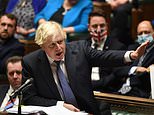
Boris Johnson speaking during Prime Minister’s Questions in the House of Commons
A 20-hour weekly limit would only cover Sir Geoffrey Cox (right), who earns huge sums through legal work spanning more than 1,000 hours a year. Such a limit could let Sir Geoffrey cut back his hours and retain his main outside work for the British Virgin Islands, for which he is paid £400,000 a year for 40 hours a month. And disgraced Owen Paterson (left), who resigned for breaching paid lobbying rules, might not have been covered by the ban
A 15-hour weekly limit might also include Conservative MP Dan Poulter, who works as a doctor, and Tory Andrew Murrison, a naval reserve surgeon who helped with the Covid vaccination rollout.
The Guardian reported a 10-hour limit would include former minister John Redwood, who has been working 12.5 hours a week as chair of the Investment Committee of Charles Stanley, earning £48,222 a quarter.
Just two Tories in 48 MPs with consultancy jobs directly fitted the description of parliamentary adviser because the proposed ban on MPs being parliamentary advisers is so narrowly worded.
According to the Register of Interests, Tory MP Philip Davies is listed as a parliamentary adviser on pawnbroking to the National Pawnbroking Association, earning £1,000 a month for five to 10 hours.
Conservative MP Laurence Robertson is also a parliamentary adviser on sport and safer gambling to the Betting and Gaming Council, and is paid £2,000 a month for 10 hours a month.
It comes as the Prime Minister admitted that he ‘crashed the car into a ditch’ while trying to defend lobbying sleaze shame MP Owen Paterson as he faced furious Tory MPs at the end of a bruising day.
Mr Johnson met the 1922 Committee of backbenchers last night after an explosive PMQs and a torrid few weeks for his party over his attempt to rewrite Parliament’s anti-corruption rules.
He has tried to draw a line under the chaos by pledging to ban MPs from working as consultants on the side after Mr Paterson broke standards rules to act as an advocate for a firm paying him a six-figure salary.
Mr Johnson also suggested MPs should have limits placed on the time they spend on second jobs – with both changes possibly costing dozens of his own backbenchers significant sums.
He later saw off a Labour motion calling for a ban on ‘any paid work to provide services as a parliamentary strategist, adviser or consultant’. The change was rejected by 282 votes to 231, a majority of 51.
MPs voted down Labour’s plans to introduce new rules to curb their outside business interests, something which has increased tensions between Boris Johnson and Tory backbenchers.
Labour’s proposals called for a ban on ‘any paid work to provide services as a parliamentary strategist, adviser or consultant’.
Crucially, it also included provisions requiring the Commons Standards Committee to come forward with proposals to implement the ban and guaranteeing time on the floor of the House for MPs to debate and vote on them.
In contrast, the more vaguely worded Government amendment simply described the consultancy ban as ‘the basis of a viable approach’ and supports the work of the Standards Committee to update the MPs’ code of conduct.
Labour leader Sir Keir Starmer during Prime Minister’s Questions at the House of Commons
Labour’s motion was rejected by 282 votes to 231, majority 51, while the Government’s amendment on standards was approved by 297 votes to zero, majority 297.
No Labour MPs backed the amendment, but the division list showed four Conservative MPs rebelled to support Labour’s motion – Peter Bone (Wellingborough), Philip Hollobone (Kettering), Nigel Mills (Amber Valley), and Dan Poulter (Central Suffolk and North Ipswich).
Speaking after the vote, Labour leader Sir Keir Starmer said: ‘We put forward a plan of action to clean up politics and strengthen standards in politics.
‘And if you can believe it, after two weeks of Tory sleaze and corruption, the Prime Minister whipped his MPs against that plan of action, and, frankly, he just doesn’t get.’
Sir Keir said: ‘We are not going to back down from these proposals, we’re not prepared to have them watered down, so we will press on with them. But it is unbelievable.’
Under the Government’s proposals, set out in a letter to Commons Speaker Sir Lindsay Hoyle, rules would be updated to include two key recommendations from the Committee on Standards in Public Life’s report on MPs’ outside interests from 2018.
These include changing the code of conduct so that any outside work should be ‘within reasonable limits’ and ‘not prevent them from fully carrying out’ their duties.
Those who failed to comply should be ‘investigated and appropriately punished’.
The changes would also ban MPs from accepting paid work as a parliamentary strategist, adviser or consultant, and from accepting payment or offers of employment to act as political consultants.
A Government spokesperson said: ‘The House of Commons has tonight voted to update the Code of Conduct for MPs.
‘This means that MPs will be banned from acting as paid political consultants or lobbyists and that MPs are always prioritising their constituents.
‘This will strengthen our parliamentary system and we will work on a cross-party basis to achieve this.’
But Chris Bryant, the Labour chairman of the Committee on Standards, replied to the statement on Twitter saying: ‘Except it doesn’t mean that. We haven’t changed anything yet.’
Mr Bryant then added in a statement that he hoped to have a final report on the committee’s proposed changes ready to present to the Commons in early 2022.
He said: ‘Any changes to the code would then require the Government to table the necessary motions and allow time for a debate on the floor of the House.’
The changes are likely to deepen tensions between Tory MPs.
Earlier, Sir Geoffrey Clifton-Brown, treasurer of the 1922 Committee, said there was ‘dissatisfaction’ with the Prime Minister in the Tory ranks.
And speaking to GB News, former minister Johnny Mercer said: ‘There are serious problems in the quality of our politics at the moment.’
The Tory MP for Plymouth Moor View, who has been outspoken against the Government since losing his job as veterans minister, added that he had ‘no relationship’ with Mr Johnson, despite initially backing him as leader.
While Sir Keir said: ‘I’ve been really struck by how many Tory MPs seem to have lost faith and confidence in the Prime Minister.
‘It was noticeable at Prime Minister’s Questions today that their benches were with many gaps, many MPs hadn’t turned up to support him.’
However, Mr Johnson was greeted at the 1922 Committee of backbench MPs on Wednesday evening, prior to the vote, to loud banging on the tables in approval.
It was reported that he told MPs ‘on a clear road I crashed the car into a ditch’ in the saga surrounding former Tory MP Mr Paterson, who was found to have breached lobbying rules.
Speaker of the House Sir Lindsay Hoyle speaks during Prime Minister’s Questions
But one backbencher said that the vast majority of questions at the meeting were surrounding the issue of small boats and immigration.
Earlier on Wednesday, Mr Johnson admitted the initial effort to shield Mr Paterson from immediate suspension to enable a review of his case and the disciplinary process had been an error.
‘The intention genuinely was not to exonerate anybody, the intention was to see whether there was some way in which, on a cross-party basis, we could improve the system,’ Mr Johnson told the Liaison Committee of senior MPs.
‘In retrospect it was obviously, obviously mistaken to think we could conflate the two things and do I regret that decision?
‘Yes I certainly do.’
Mr Paterson quit as an MP rather than face a vote on his suspension after the Government abandoned its bid to shield him from an immediate sanction.
The PM also insisted he wanted to find a cross-party approach to the Westminster sleaze rows but became involved in spiky Commons exchanges with Sir Keir during PMQs over his own outside earnings as a lawyer prior to becoming Labour leader.
The Speaker repeatedly ordered Mr Johnson to stop asking Sir Keir questions and said the exchanges had been ‘ill-tempered’, adding: ‘I need this House to gain respect but it starts by individuals showing respect for each other.’