

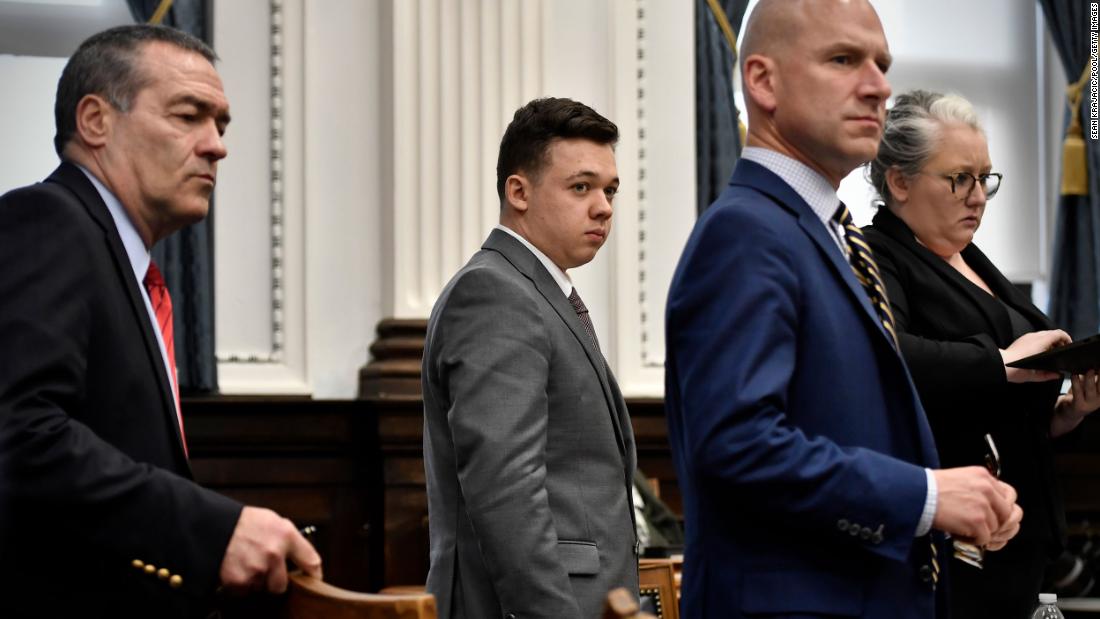
Rittenhouse provoked fatal shootings by pointing AR-15 at man, prosecutors say in closing arguments
“That is what provokes this entire incident,” prosecutor Thomas Binger said. “When the defendant provokes this incident, he loses the right to self-defense. You cannot claim self-defense against a danger you create.”
The trial, Binger said, was not about politics, or looting, or rioting — but instead about how life is more important than property.
“I think we can also agree that we should not have 17-year-olds running around our streets with AR-15s, because this is exactly what happens,” he said.
The closing arguments began midday Monday and are set to last up to five hours. The jury of eight men and 10 women will then be narrowed to 12 people by a drawing of names before deliberations begin.
Rosenbaum and Huber were killed, and Grosskreutz was wounded.
The trial featured more than a dozen videos from the night, showing what happened before, during and after the shootings. Most of the facts of what happened that night were not up for debate — rather, the heart of the trial was the analysis of Rittenhouse’s actions and whether they can be considered “reasonable.”
Judge dismisses weapons charge
Rittenhouse is charged with first-degree reckless homicide in the death of Rosenbaum, first-degree recklessly endangering safety or endangering Richard McGinnis, and attempted first-degree recklessly endangering safety for endangering an unknown person identified in court as “jump kick man.”
He is also charged with first-degree intentional homicide while using a dangerous weapon for the killing of Huber. It is the most severe charge Rittenhouse faces and the only charge that carries a mandatory sentence of life in prison.
Judge Schroeder gave jurors instructions on Monday for the lesser included offenses of second-degree intentional homicide and first-degree reckless homicide for Huber’s death. Both lesser offenses are punishable by up to 60 years in prison.
For shooting Grosskreutz, Rittenhouse is charged with attempted first-degree intentional homicide, punishable by up to 60 years in prison. Judge Schroeder also gave jurors instructions on lesser offenses of attempted second-degree intentional homicide or first-degree recklessly endangering safety.
The instructions to the jury Monday stretched for over an hour. Judge Schroeder stopped midway through to discuss them with the attorneys further and noted how convoluted the instructions are.
“They are certainly correct in what they say, I just think they are not clear,” he said.
In a conference Friday about jury instructions, the judge told Rittenhouse presenting lesser offenses to the jury lowers the possibility of a second trial but increases the risk of a conviction. Schroeder explained if the prosecution is not able to establish Rittenhouse’s guilt on the charged offense beyond a reasonable doubt, then the jury must acquit him.
How testimony played out
In his testimony, Rittenhouse indicated he knew Rosenbaum was unarmed when the man ran toward him and admitted he pointed the gun at Rosenbaum to deter him. Rittenhouse noted he was aware pointing a rifle at someone is dangerous.
“He was chasing me, I was alone, he threatened to kill me earlier that night. I didn’t want to have to shoot him,” Rittenhouse testified. “I pointed it at him because he kept running at me, and I didn’t want him to chase me.”
Rittenhouse said he feared Rosenbaum — who did not touch him — would take his gun and kill people.
Rittenhouse testified he fled the scene after shooting Rosenbaum and tried to reach police to turn himself in. A crowd of people pursued him, yelling that he had shot someone, and several people confronted him when he fell to the ground. Rittenhouse then twice at a man who tried to kick him, once at Huber and once at Grosskreutz.
Grosskreutz acknowledged at one point in their standoff he pointed his pistol at Rittenhouse. But he said he never did so intentionally and did not fire at the teenager.
“I was never trying to kill the defendant,” he said. “In that moment, I was trying to preserve my own life, but doing so while taking the life of another is not something I am capable or comfortable doing.”
In addition, Grosskreutz acknowledged he incorrectly told police last year his firearm had fallen out of his pants that night and did not admit he had a weapon at the time. He also admitted his concealed carry license had expired and he had not renewed it.
Wisconsin Gov. Tony Evers has 500 National Guard troops on standby outside of Kenosha, ahead of a possible verdict.
“The Kenosha community has been strong, resilient, and has come together through incredibly difficult times these past two years, and that healing is still ongoing,” Evers said in a statement Friday. “I urge folks who are otherwise not from the area to please respect the community by reconsidering any plans to travel there and encourage those who might choose to assemble and exercise their First Amendment rights to do so safely and peacefully.”
CNN’s Steve Almasy, Aya Elamroussi and Amir Vera contributed to this report.