

UK’s daily Covid cases are ‘worryingly close to 100,000’, symptom-tracking study claims
UK’s daily Covid cases are ‘worryingly close to 100,000’, symptom-tracking study claims despite official infection numbers trending down — as top scientist says it’s ‘clear No10’s figures are a big under-estimate’
King’s College London researchers estimated there were 92,953 people falling ill with the virus last week Cases are rising across all age groups, although the proportion of cases remains highest in under-18s Professor Tim Spector warns Government data showing a downfall in cases underestimates the crisis
<!–
<!–
<!–<!–
<!–
(function (src, d, tag){
var s = d.createElement(tag), prev = d.getElementsByTagName(tag)[0];
s.src = src;
prev.parentNode.insertBefore(s, prev);
}(“https://www.dailymail.co.uk/static/gunther/1.17.0/async_bundle–.js”, document, “script”));
<!–
DM.loadCSS(“https://www.dailymail.co.uk/static/gunther/gunther-2159/video_bundle–.css”);
<!–
Britain is ‘worryingly close’ to 100,000 new Covid infections per day, the country’s largest symptom-tracking study warned today despite Government data showing the outbreak is in retreat.
King’s College London researchers estimated there were 92,953 people falling ill with the virus on average across the UK last week, up 14 per cent on the previous seven days.
Cases are rising across all age groups, although the proportion of cases remains highest in under-18s with nearly 44,000 infected on any given day. There was also uptick in the rate of increase in the more vulnerable age groups 55 to 75, the researchers said.
The latest survey figures were based on data from around 43,000 lateral flow and PCR tests done between October 9 and October 23.
Professor Tim Spector, the epidemiologist who leads the study, warned that the Government’s figures were a ‘big underestimate’ and may be missing 40 per cent of cases.
The Department of Health’s daily reports only include cases confirmed by a PCR test — which are more reliable than lateral flow devices. They showed new infections fell for the fourth day in a row yesterday, dropping 10.6 per cent to 43,941.
SAGE member Professor John Edmunds, whose grim modelling in July predicted hospitalisations would have reached 3,500 a day by now, said the fall in cases may have been caused by rising immunity in children.
And the low numbers in the official figures have lead to Government sources claiming the chance of ministers activating their winter Covid ‘Plan B’ is less than 20 per cent.
But Sir Patrick Vallance today called on Boris Johnson to go ‘hard and early’ and reimpose Covid restrictions at the first sign of infections rebounding in the UK.
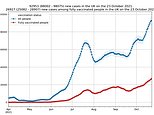
King’s College London researchers estimated there were 92,953 people falling ill with the virus on average across the UK last week, up 14 per cent on the previous seven days
Cases are rising across all age groups, although the proportion of cases remains highest in under-18s (blue line) with nearly 44,000 infected on any given day
Cases are high in all regions of England and highest in the North West (purple line), where they are in excess of 2,000 per 100,000 people
Professor Spector said: ‘The ZOE data shows the UK could hit 100,000 new cases sooner than expected and with no sign of a Plan B or Plan C.
‘The ZOE figures are consistently higher than the official confirmed daily cases because we get results from various sources, including self-reported lateral flow tests that are under-reported officially.
‘The government raw figures report on PCR testing of the classical symptoms only, which miss around 40 percent of cases.
‘ZOE extrapolates the data from our sample to predict daily infections in the wider population.
‘With the confirmation of our estimates from the ONS’s fortnightly survey, it’s clear the government figures are a big under-estimate, and with the highest rates in Western Europe, there’s no room for complacency.’
The ZOE data estimates the UK R rate is around 1.1 — meaning the outbreak is growing — with an average of one in 56 people becoming ill with the virus.
Cases are high in all regions of England and highest in the North West, where they are in excess of 2,000 per 100,000 people. In total 11,182 people — one in 48 —per day in the region were infected last week.
The South West saw the biggest jump in cases, increasing from around 1,250 to 2,000 per 100,000 in a week. One in 51 people were ill with the virus.
And Covid prevalence remains highest in Wales, where more than 2,250
Professor Spector continued: ‘We now know that masks add a layer of protection, so wearing them on public transport and in crowded places is a good idea.
‘Avoiding unventilated crowded events is another, as well as working more from home.
‘Finally, staying at home and getting tested when you feel unwell is key.
‘There’s a lot of cold and flu out there making it harder than ever to tell the difference between a harmless cold or Covid.
‘However, there are some symptoms that are very telling of Covid, particularly loss of smell and taste. If you feel ill, always check by taking a quick and easy Lateral Flow Test, even if you think it’s just a cold.’
Professor Edmunds yesterday said the spike in infections over the last few months was driven by ‘huge numbers of cases’ in youngsters. Health officials estimate as many as one in 12 children across England were carrying the virus last week.
But he said the surge in infections ‘will eventually lead to high levels of immunity in children’ which will see cases plateau and then fall, Professor Edmunds said. He added that it ‘may be that we’re achieving that now’.
Daily Covid infections in the UK breached the 50,000 barrier last week. It prompted medical unions, some scientists and Labour to call for Plan B — mandatory face masks, work from home guidance and vaccine passports — to be implemented immediately in a bid to control infections.
But optimistic modelling from SAGE has claimed infections may even slump to the 5,000 mark over the coming months, even without No10 caving into demands and resorting to virus-controlling interventions.
Scientists said a combination of booster vaccines, growing natural immunity in children and a drop in classroom mixing during the October half-term break would drag cases down.
Department of Health data suggests Covid cases have now peaked among school children, in a positive sign that they could soon fall in other age groups that they are passing the virus on to.
Its figures are published by when people actually took their test, rather than when they got their result, which experts say is more reliable because it accounts for reporting delays.
Cases among 10 to 14-year-olds — the age group with the highest infection rate — may have peaked on October 19 at 1,925.2 positive tests per 100,000 people.
For 15 to 19-year-olds and five to nine-year-olds, the rate also hit a high on October 19 of 861.3 and 760.7, respectively.