

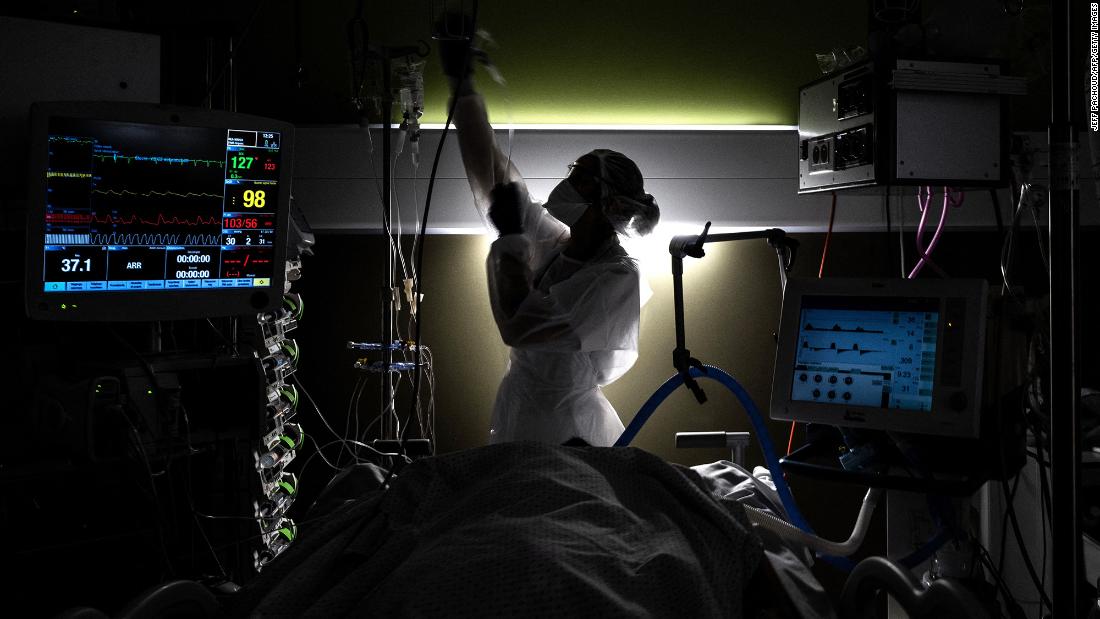
Are European hospitals ready for another pandemic fall?
However, vaccination rollouts have kept hospital admissions far below where they were in the first months of 2021.
As a result, Europe presents a varied picture as governments brace for a potential rise in cases in the autumn and winter months.
Here’s the situation in five key European countries.
The UK
But the UK’s strong vaccination rollout has kept numbers far below where they were in the winter peak; in January more than 4,000 people were admitted to British hospitals every day with the virus, despite cases being only slightly higher than they are now.
On Tuesday, Prime Minister Boris Johnson warned that restrictions could return in the winter if the country’s National Health Service (NHS) risks becoming overwhelmed. “Covid is still out there. The disease sadly still remains a risk,” he said at a press conference.
France
Hospital admissions in France rose throughout August, amid warnings of a fourth wave of the virus hitting facilities across the country. By the end of the month more than 11,000 people were in hospitals with Covid-19.
France has implemented strict restrictions on unvaccinated people in an effort to advance its rollout. As of Thursday, healthcare workers are required to be fully immunized, and “health passes” are needed in order to enter restaurants or travel long distances.
Italy
The country has seen just under 5,000 hospitalizations in recent days.
After being hit hard in the early stages of the first wave, Italy was one of the first countries to reopen to visitors in 2020. In 2021, entry has been largely limited to residents of the European Union, plus a select list of non-EU countries, including the USA, Canada, Japan and the UK.
Italy on Thursday became the first country in Europe to make it mandatory for all public and private sector workers to show proof of vaccination, a negative test or a recent recovery from infection. The rule is aimed at persuading more people to get vaccinated against Covid-19, and is due to come into force on October 15.
“This is to make these [work] places safer, and make the vaccination campaign even stronger,” Italian Health Minister Roberto Speranza said. He called the decree “a strategy that points on the vaccine as fundamental key to open a new season.” Around 75% of the Italian population aged 12 years and over have currently been fully vaccinated, according to government figures.
Ireland
Ireland has fared better than some of its closest neighbors in terms of case numbers and deaths, which are among the lowest in Europe — thanks in large part to one of Europe’s harshest lockdowns throughout the pandemic.
There are now signs of a plateau in hospital admissions — around 60 people have been in intensive care units each day throughout September, compared to a peak of 221 in January.
Unlike the neighboring UK, Ireland is still limiting capacity at large indoor and outdoor events, including sporting fixtures.
Ireland’s restrictions are set to be eased from September 20, with fully vaccinated people allowed to meet indoors in groups of up to 100. From October 22, the government plans to remove the final remaining restrictions on face coverings, social distancing and large gatherings.
Denmark
Denmark essentially returned to pre-pandemic life this month, allowing citizens to enter nightclubs and restaurants without showing a “Covid passport,” use public transport without wearing a face covering and meet in large numbers without restrictions.
The transmission rate, or R-rate, currently stands at 0.7, Health Minister Magnus Heunicke tweeted Wednesday, meaning that the epidemic is continuing to shrink. If it’s above 1.0, Covid-19 cases will increase in the near future. If it’s below 1.0, cases will decrease in the near future.
“The vaccines and all citizens in Denmark’s great efforts over a long period of time are the basis for us to do so well,” Heunicke said.
The country has seen far lower case rates than its neighbor Sweden, which became an outlier in western Europe when it resisted a strict lockdown in 2020. But the two nations are now roughly in line in terms of hospitalizations.
CNN’s Sarah Dean, Nicolo Ruotolo and Laura Smith-Spark contributed reporting.