

Trump’s former national security advisers say he has ‘no moral compass’ in new Woodward book
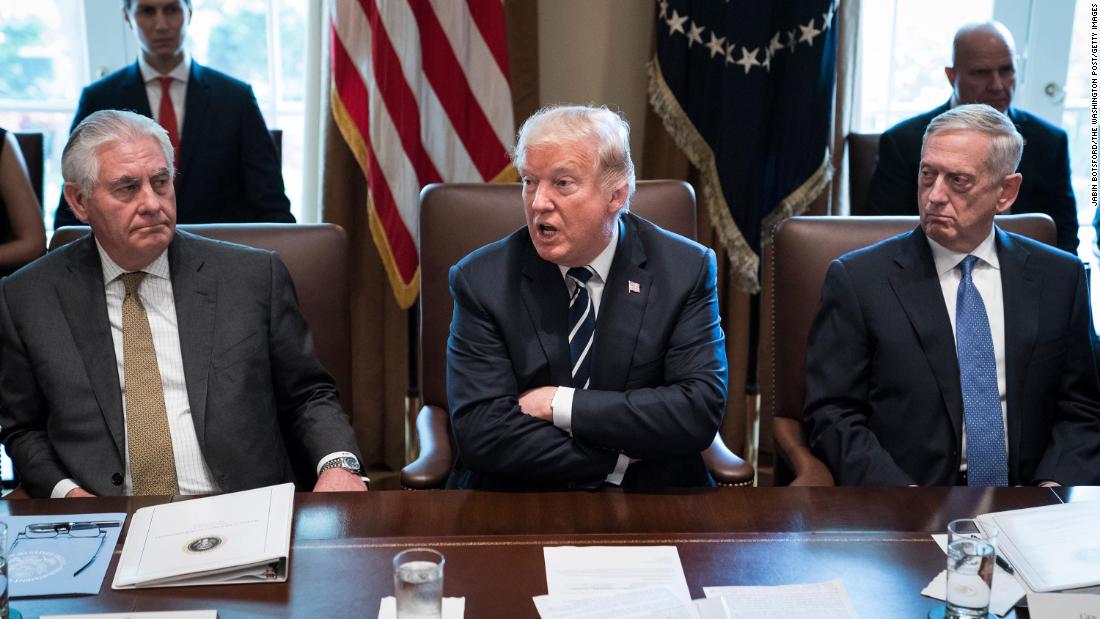
The book is filled with searing indictments of Trump. Mattis is quoted criticizing the President both for his chaotic process and ill-advised, go-it-alone policy decisions. When Trump says he wants to withdraw US troops from Afghanistan and South Korea, Mattis privately told Coats, “That’s dangerous,” Woodward reports. “The President has no moral compass.”
Coats agreed. He’s quoted as saying, “To him, a lie is not a lie. It’s just what he thinks. He doesn’t know the difference between the truth and a lie.”
Mattis is quoted as saying Trump took foreign policy actions that showed adversaries “how to destroy America. That’s what we’re showing them. How to isolate us from all of our allies. How to take us down. And it’s working very well.”
Trump himself also criticized military officials to Woodward over their view that alliances with NATO and South Korea are the best bargain the US makes. “I wouldn’t say they were stupid, because I would never say that about our military people,” Trump said. “But if they said that, they — whoever said that was stupid. It’s a horrible bargain … they make so much money. Costs us $10 billion. We’re suckers.”
‘Play on the dark side’
In a remarkable revelation, Woodward writes that Coats “continued to harbor the secret belief, one that had grown rather than lessened, although unsupported by intelligence proof, that Putin had something on Trump.”
Coats and his top staffers “examined the intelligence as carefully as possible,” Woodward writes. “There was no proof, period. But Coats’s doubts continued, never fully dissipating.”
“How else to explain the president’s behavior? Coats could see no other explanation,” Woodward writes. “He was sure that Trump had chosen to play on the dark side — the moneyed interests in the New York real estate culture, and international finance with its corrupt, anything-to-make-a-buck dealmaking. Anything to get ahead, anything to make a deal.”
Coats also felt that leaders like Putin and Turkish President Recep Tayyip Erdogan had lied to Trump. Woodward writes that Coats believed they “played Trump skillfully. They would roll out the red carpet for him, flatter him, then do what they wanted.”
Coats believed that Trump’s isolation in the White House was making him become more paranoid and lonely, Woodward writes.
Mattis struggled with the challenge of not only facing the possibility of nuclear war with North Korea, but of Trump escalating the situation with his Twitter insults. Mattis is quoted as saying he was “often trying to impose reason over impulse.” He said he got little guidance from Trump “other than an occasional tweet.”
Mattis is quoted as saying it was difficult to brief Trump, because the discussion could “go off on what I kind of irreverently call those Seattle freeway off-ramps to nowhere.”
“So you just had to deal with it,” Mattis is quoted as saying. “It was, how do you govern this country and try to keep this experiment alive for one more year?”
‘A disturbed mind’
Former Deputy Attorney General Rod Rosenstein was a frequent target of Trump’s Twitter tirades over special counsel Robert Mueller’s investigation. Woodward writes Rosenstein could see firsthand how Trump was obsessed with FBI Director James Comey before Comey’s firing in May 2017. When Trump showed Rosenstein a draft letter justifying why he wanted to fire Comey, Rosenstein is quoted as saying the letter “showed a disturbed mind.”
Dr. Anthony Fauci, a key White House coronavirus task force member and the nation’s leading infectious disease expert, is quoted telling others Trump’s leadership on the virus was “rudderless” and his “sole purpose is to get reelected.”
Even some of Trump’s allies are quoted in “Rage” as being deeply troubled by the President.
“Right now his presidency’s very much at risk,” Graham is quoted as saying. “This thing has the potential now to eat him alive.”
In a surprising anecdote, Woodward reports former President George W. Bush, who has kept a low profile, called Graham with some advice about how to deliver a potential Covid-19 vaccine to the developing world.
“You tell the president if he does this,” Bush said, “it’ll really help him a lot.”
“I will,” Graham said. “Would you want to talk to Trump?”
“No, no,” Bush replied. “He’d misconstrue anything I said.”
‘He’s dangerous’
Woodward recounts a revealing conversation between Coats and Mattis. After Mattis had resigned, he and Coats discussed whether they might have to “stand up and speak out” and “take collective action.”
“He’s dangerous,” Mattis said. “He’s unfit.”
Mattis is quoted as saying, “We can’t let the country keep going” on this course, Woodward writes. “This is dangerous.”
CNN’s Elizabeth Stuart contributed to this report.