

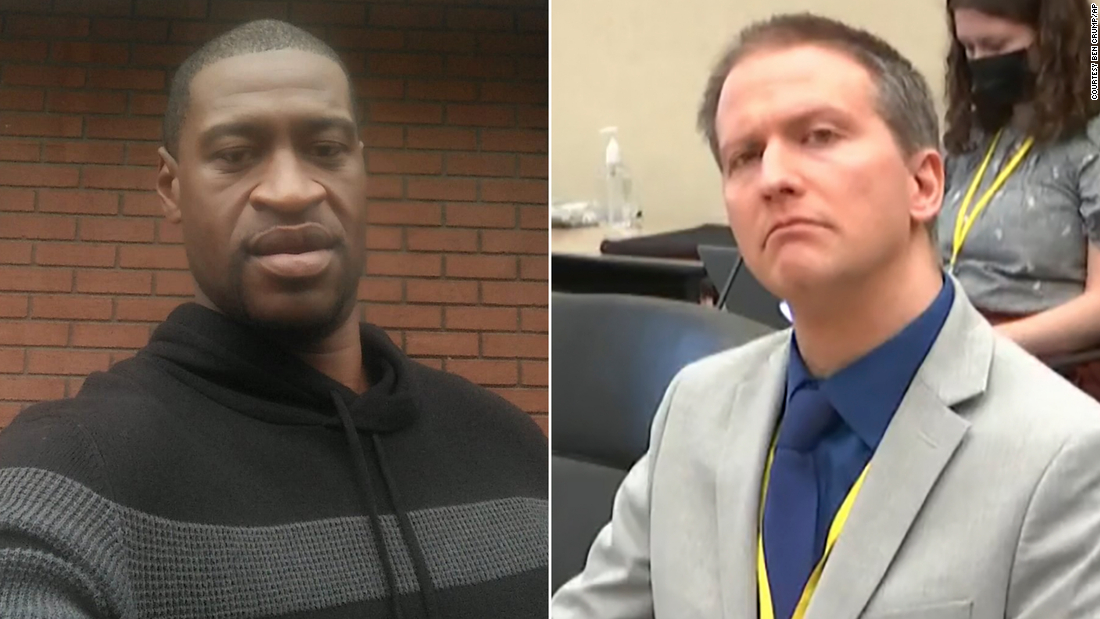
Jury has reached a verdict in Derek Chauvin’s trial
Prosecutors have repeatedly told jurors to “believe your eyes” and rely on the infamous bystander video of Floyd’s death.
“This case is exactly what you thought when you saw it first, when you saw that video. It is exactly that. You can believe your eyes,” prosecuting attorney Steve Schleicher said in closing arguments. “This wasn’t policing. This was murder.”

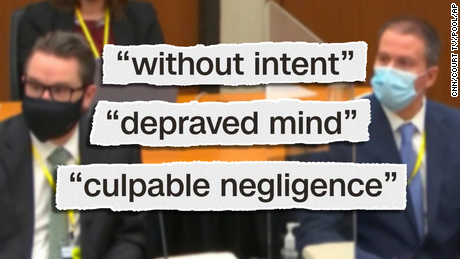
The charges are to be considered separate, so Chauvin could be convicted of all, some or none of them. If convicted, Chauvin could face up to 40 years in prison for second-degree murder, up to 25 years for third-degree murder and up to 10 years for second-degree manslaughter.
The actual sentences would likely be much lower, though, because Chauvin has no prior convictions. Minnesota’s sentencing guidelines recommend about 12.5 years in prison for each murder charge and about four years for the manslaughter charge.
A nation waits on edge
Floyd’s death last May set off unrest and mass protests challenging the ways that police treat Black people in the US. In a first for Minnesota, the trial has been broadcast live in its entirety to accommodate Covid-19 attendance restrictions, giving the public a rare look into the heart of the legal system.

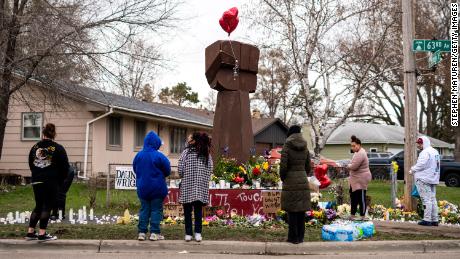
More than 3,000 Minnesota National Guard members have also been activated in the Twin Cities, while businesses in Minneapolis have boarded up windows.
President Joe Biden on Tuesday said he is praying for the “right” verdict in the case, noting that the evidence is, in his view, “overwhelming.” He also said he spoke with Floyd’s family on Monday.
“They’re a good family, and they’re calling for peace and tranquility, no matter what that verdict is,” he told reporters in the Oval Office.
Prosecutor says trial is ‘pro-police’
Finally, five separate medical experts explained that Floyd died from a lack of oxygen when Chauvin restricted his ability to breathe in what’s known as “positional asphyxia.”

“He was not going to let these bystanders tell him what to do. He was going to do what he wanted, how he wanted, for as long as he wanted. And there was nothing, nothing they can do about it because he had the authority. He had the power, and the other officers, the bystanders were powerless,” he said. “He was trying to win, and George Floyd paid for it with his life.”
He contrasted Chauvin’s “ego-based pride” with the proper feelings of pride in wearing a police badge and praised policing as a noble profession. He insisted the state was prosecuting Chauvin individually — not policing in general.
“This is not an anti-police prosecution; it is a pro-police prosecution,” he said. “There is nothing worse for good police than bad police.”
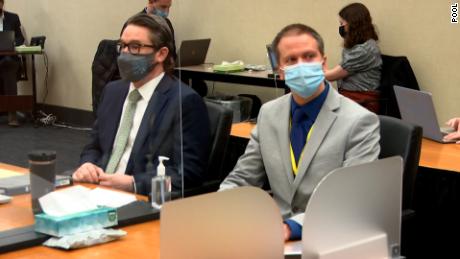
In response, Nelson said Chauvin acted as a “reasonable officer” would in that situation and said there was no evidence he intentionally or purposefully used force that was unlawful.
“You have to look at it from the reasonable police officer standard. You have to take into account that officers are human beings, capable of making mistakes in highly stressful situations,” Nelson said. “In this case, the totality of the circumstances that were known to a reasonable police officer in the precise moment the force was used demonstrates that this was an authorized use of force, as unattractive as it may be. This is reasonable doubt.”
CNN’s Betsy Klein and Brad Parks contributed to this report.