

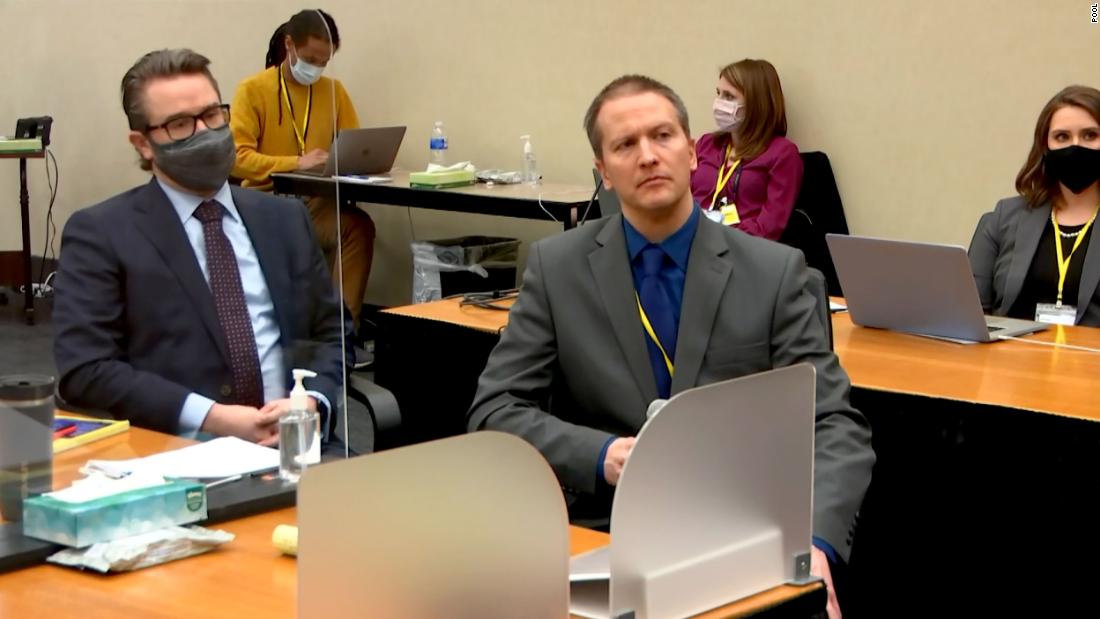
Chauvin kneeled on George Floyd for more than 9 minutes because of ex-officer’s pride and ego, prosecutor says
“He was not going to let these bystanders tell him what to do. He was going to do what he wanted, how he wanted, for as long as he wanted. And there was nothing, nothing they can do about it because he had the authority. He had the power, and the other officers, the bystanders were powerless,” prosecuting attorney Steve Schleicher said. “He was trying to win, and George Floyd paid for it with his life.”
The comments about Chauvin’s pride and ego were the first time prosecutors have specifically discussed Chauvin’s mindset when Floyd died on May 25, 2020 — elements that are key to the charges of second-degree unintentional murder, third-degree murder and second-degree manslaughter against him. Chauvin did not testify in his own defense.
Schleicher contrasted Chauvin’s “ego-based pride” with the proper feelings of pride in wearing a police badge and praised policing as a noble profession. He insisted the state was prosecuting Chauvin individually — not policing in general.
“This is not an anti-police prosecution; it is a pro-police prosecution,” he said. “There is nothing worse for good police than bad police.”
Schleicher’s closing argument relied on a series of video clips that showed Chauvin’s actions that day, linking them explicitly to the language of each charge.

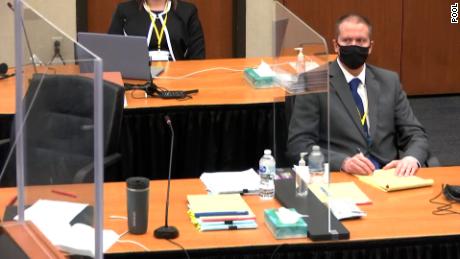
“George Floyd’s final words on May 25, 2020, were, ‘Please, I can’t breathe,’ and he said those words to Derek Chauvin,” Schleicher told the jurors. “All that was required was a little compassion, and none was shown on that day.”
At the end, Schleicher simplified the case into a concise argument: “Believe your eyes.”
“This case is exactly what you thought when you saw it first, when you saw that video. It is exactly that. You can believe your eyes. It’s exactly what you believed. It’s exactly what you saw with your eyes. It’s exactly what you knew, what you felt in your gut. It’s what you now know in your heart,” he said. “This wasn’t policing. This was murder.”
The defense is set to offer its own closing argument afterward, followed by a rebuttal from prosecuting attorney Jerry Blackwell.
On Monday morning, Judge Peter Cahill instructed jurors on the law prior to closing arguments.
The jury will then be sent off to begin deliberations in the Hennepin County Government Center. The jury will remain sequestered for deliberations and will stay in a hotel at night.
Chauvin, 45, has pleaded not guilty to all three charges. If convicted, he could face up to 40 years in prison for second-degree murder, up to 25 years for third-degree murder, and up to 10 years for second-degree manslaughter. The charges are to be considered separate, so Chauvin could be convicted of all, some or none of them.
The end of the trial comes 11 months after Floyd’s death on a Minneapolis street set off widespread protests about how police treat Black people.

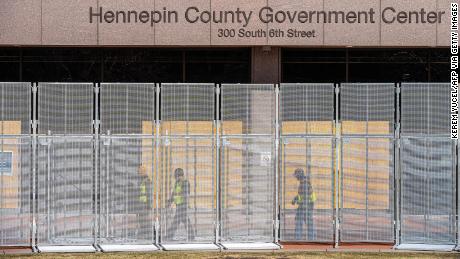
Workers install security fencing March 3 at the Hennepin County Government Headquarters in Minneapolis.
45 witnesses over 3 weeks of testimony
The prosecution’s case against Chauvin fit into three distinct phases with 38 witnesses: what happened to Floyd last May, the Minneapolis Police use-of-force policy and the medical analysis of why Floyd died.
The first week of testimony largely focused on Floyd’s final moments and the distressed bystanders who watched Chauvin kneel on Floyd while he was handcuffed and prone on the street. Video from the bystanders and police body camera footage showed Floyd’s gasps for air and calls for his “mama” over those excruciating minutes, leaving several witnesses in tears.
“That in no way, shape or form is anything that is by policy. It is not part of our training, and it is certainly not part of our ethics or our values,” Arradondo said.

Floyd’s preexisting health conditions and drug use were not relevant to his death, Tobin said.
“A healthy person subjected to what Mr. Floyd was subjected to would have died,” he said.
In contrast, the former Minneapolis Police officer’s defense team called seven witnesses — but Chauvin was not among them.
A police use-of-force expert testified that Chauvin’s restraint of Floyd was “justified,” and a forensic pathologist testified that Floyd’s cause of death was “undetermined,” saying his underlying heart issues were the main causes.
“In my opinion, Mr. Floyd had a sudden cardiac arrhythmia, or cardiac arrhythmia, due to his atherosclerosis and hypertensive heart disease … during his restraint and subdual by the police,” said Dr. David Fowler, a forensic pathologist who retired as Maryland’s chief medical examiner at the end of 2019.
Several other defense witnesses have testified about Floyd’s drug use, particularly during a prior arrest in May 2019 in which he ingested opioids as police approached him in a vehicle.
Together, the witnesses furthered the defense’s three main arguments in the case: that Floyd died due to drug and health problems, that Chauvin’s use of force was ugly but appropriate, and that a hostile crowd of bystanders distracted Chauvin.
Anxiety and tensions in Minneapolis area
Tensions in the Minneapolis metropolitan area are high as Chauvin’s fate hangs in the balance and after the police shooting of Daunte Wright.
A peaceful march and protest calling for justice in his death led to unrest, and at least 100 people were arrested on Friday night, authorities said. Police declared a demonstration at the Brooklyn Center Police Department unlawful, and officers could be seen using pepper-spray and firing rubber bullets into the crowd.
In a letter to Gov. Tim Walz and public safety officials, attorneys representing news organizations laid out instances of journalists, including CNN producer Carolyn Sung, being harassed, assaulted and arrested by law enforcement while covering the protests.
Adding to the heightened tensions was a shooting Sunday morning. A state National Guard and Minneapolis Police team providing neighborhood security in Minneapolis were fired upon by a light-colored SUV, Minnesota National Guard spokesman Lt. Col. Scott Hawks told CNN in an email.
No members were seriously injured, but two members suffered minor injuries.
CNN’s Ray Sanchez and Brad Parks contributed to this report.