


US records 1 million new cases only five days into December
“We’re seeing day-by-day increasing numbers of patients with Covid-19, both those who are a little bit sick and those who are really sick,” said Dr. Megan Ranney, a CNN medical analyst and director of the Brown-Lifespan Center for Digital Health at Brown University in Providence, Rhode Island.
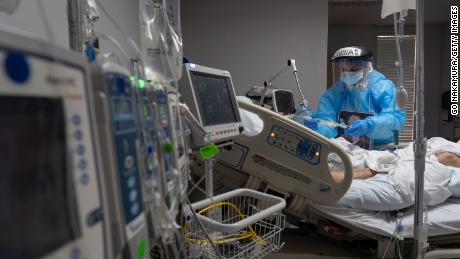
“As that happens, our hospitals are filling up, and our workers are getting sick. Our floors are short on techs, on respiratory therapists, on nurses,” said Ranney, adding, “We are on the verge of being in a crisis state.”
“Everywhere we’re seeing a surge,” said Dr. Carlos del Rio, an infectious disease physician and executive associate dean of Emory University School of Medicine. “And the biggest problem when you have a surge is, it’s not the space, it’s not the stuff, it’s actually the staff. Staff are tired, sick and I’m worried we’re running out of staff to take care of patients.”
Dr. Shirlee Xie, a hospitalist and associate director of hospital medicine for Hennepin Healthcare in Minneapolis, said health care workers are “suffocating” in their patients’ fear and in their colleagues’ exhaustion.
“Every single day, thousands more people are getting this virus, and we know that means that in a few days, in a week, hundreds of people are going to be coming to the hospital and hundreds of people are going to die,” she told CNN’s Ana Cabrera, her voice breaking with emotion.
“I think that sometimes when you hear statistics like that, you become numb to what those numbers mean,” Xie said. “But for us, the people that are taking care of these patients, every single number is somebody that we have to look at and say, ‘I’m sorry, there’s nothing more I can do for you.'”
More than 100,000 Covid-19 patients have been hospitalized nationwide for the past four days, according to the Covid Tracking Project.
Unlike the spring, a couple of weeks from now, “It won’t just be a couple of hospitals or a couple of regions or states where they’re running out of ICU beds, which is happening, but it will finally be the whole country,” Dr. Jeremy Faust, an emergency physician at Brigham and Women’s Hospital in Boston, told CNN’s Wolf Blitzer.
“Once we run out of hospital beds, we are going to face something the likes of which we have never seen before,” he said.

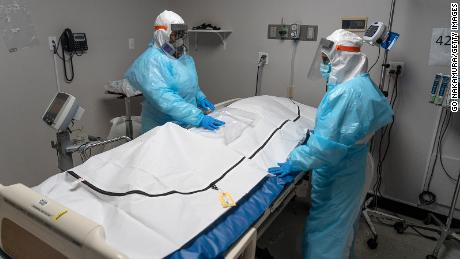
As of Friday the US averaged 182,633 daily new cases over the last week, a record high for the country, according to Johns Hopkins University data. And the average number of daily Covid-19 deaths across a week hit 2,010 on Friday, the highest it has been since April.
The US recorded 227,885 cases on Friday alone, the highest one-day count of the pandemic.
But health officials warn that while some Americans may receive a vaccine by the end of the year, the country likely won’t see any meaningful impacts until late spring.
In the meantime, experts project an incredibly challenging next few months.
Millions of Californians face stay-at-home orders
More than 278,800 people have lost their lives to the virus in the US since the pandemic began. More than 10,000 of those were recorded in the four days since the beginning of December, with more than 2,500 daily deaths reported across the US each day.
Los Angeles Mayor Eric Garcetti on Friday called the accelerating pandemic “the greatest threat to life in Los Angeles that we have ever faced.” Hospitalizations in Los Angeles County have tripled in the last week, he said, and the county will likely run out of beds in two to four weeks if cases continue climbing.

In hopes of stemming the tide, large areas of California have announced new stay-at-home orders, affecting tens of millions of Californians.
While the Bay Area has not met that threshold, officials warned they’re seeing evidence of transmission over Thanksgiving weekend that could fuel a surge in their community.
“I don’t think we can wait for the state’s new restrictions to go into effect later this month,” Contra Costa Health Director Chris Farnitano said Friday. “We must act swiftly to save as many lives as we can. This is an emergency.”
There are 11 counties in the Southern California region, including five of the state’s most populated counties — Los Angeles, San Diego, Orange, Riverside and San Bernardino. Roughly 23 million people live in the region.

“It really is time for us to pull back on the activity and see if we can turn this thing around before hospitals get overwhelmed,” said Dr. Robert Wachter, chairman of the department of medicine at University of California, San Francisco, pointing out California has had a “better than average performance” throughout the pandemic.
“I see other parts of the country that are still open, even though the case rates and hospitalization rates are far worse than here,” he told CNN. “So I think we’re acting correctly.”
Here’s when most Americans will begin getting vaccinated
Dr. Anthony Fauci told CNN Friday night that healthy, non-elderly Americans with no known underlying health conditions will likely start getting vaccinated in late March to early April.
“The quicker you get the overwhelming majority of the country vaccinated, the quicker you’re going to have that umbrella of herd immunity — which would be so, so important in bringing the level of that virus way, way down to below the threatening level,” Fauci said.


Adm. Brett Giroir, assistant secretary for health at the US Department of Health and Human Services, said Friday the FDA will consider emergency use authorization of the Pfizer vaccine after the meeting of its outside advisory committee on December 10, with consideration of the Moderna vaccine not far behind.
According to Giroir, at least 20 million Americans are expected to be able to get the Covid-19 vaccine by the end of the month.
“It’s going to be very challenging. Distribution is going to be crucial,” former FDA Commissioner Dr. Margaret Hamburg told CNN Saturday, adding, that it will fall to the states to set priorities for who should get vaccinated first.
On top of that, the first vaccines require two doses, so officials will also need to keep track of how many doses each individual has received.
“This is going to be almost as hard as making the vaccine itself,” Hamburg said.
But the start of vaccinations won’t mean an end to Covid-19, and leading public health officials are warning that masks will continue to play a crucial role in helping curb the spread of the virus.
“Just 100 days to mask, not forever. One hundred days. And I think we’ll see a significant reduction,” Biden said.
CNN’s Tina Burnside, Andrea Diaz, Maggie Fox, Anastasia Graham-Yooll, Jacqueline Howard, Jon Passantino and Paul Vercammen contributed to this report.