

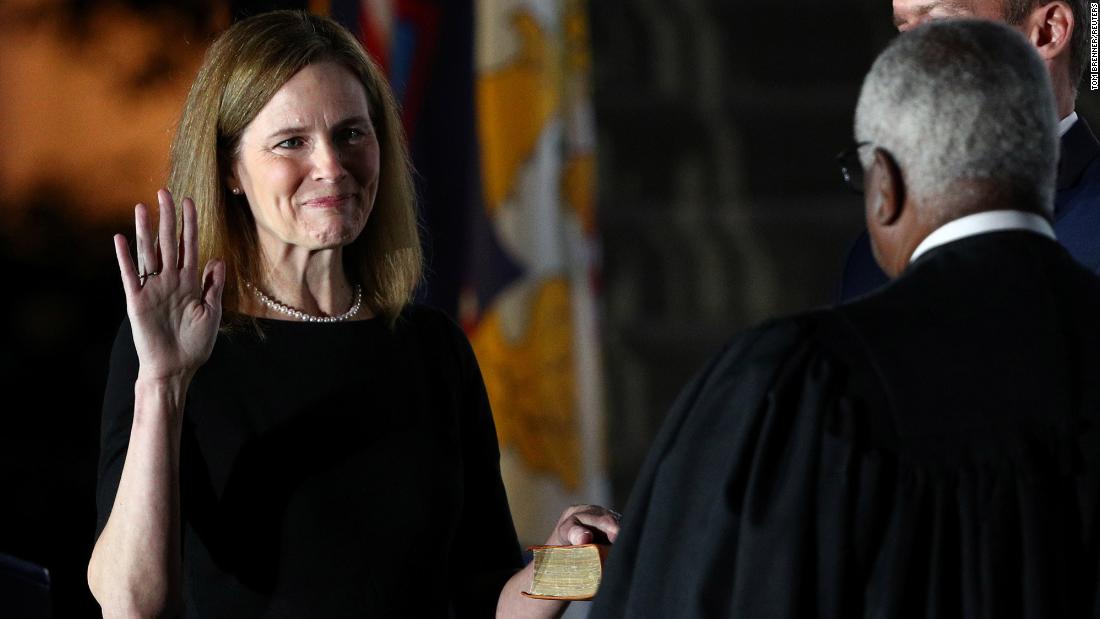
The Senate confirms Amy Coney Barrett to the US Supreme Court with a 52-48 vote, solidifying the court’s conservative majority
The vote was 52-48. Republican Sen. Susan Collins of Maine, who is in a tough reelection fight, was the only GOP senator to cross party lines and vote with Democrats against the nomination after having expressed concerns that it’s too close to Election Day to consider a nominee.
Trump’s appointment of a new Supreme Court justice marks the third of his tenure in office, giving Republicans a historic opportunity to deliver on the key conservative priority and campaign promise of transforming the federal courts through lifetime appointments.
Barrett, who is 48 years old, is likely to serve on the court for decades and will give conservatives a 6-3 majority on the Supreme Court, a shift in its makeup that could have dramatic implications for a range of issues that could come before it, including the future of the Affordable Care Act and any potential disputes regarding the 2020 election.


Senate Republicans, who hold a majority in the chamber, pushed ahead with one of the quickest nomination proceedings in modern times following the death of the late Justice and liberal icon Ruth Bader Ginsburg last month.
They moved to confirm Barrett over the objections of Democrats who have argued that the process has been a rushed and cynical power grab that threatens to undermine Ginsburg’s legacy.
“By any objective standard, Judge Barrett deserves to be confirmed to the Supreme Court. The American people agree. In just a few minutes, she’ll be on the Supreme Court,” Senate Majority Leader Mitch McConnell said ahead of the final confirmation vote.
Justice Clarence Thomas will administer the official Constitutional Oath to Barrett at the White House, a senior White House official told CNN.
The confirmation battle has played out in a bitterly-divided Senate, but the outcome has not been in question for much of the fight. With few exceptions, Senate Republicans quickly lined up in support of Barrett after her nomination by President Trump, while Democrats united in opposition.
Two Republican senators crossed party lines to vote with Democrats in opposition to a key procedural vote on Sunday — Collins and Lisa Murkowski of Alaska.
Senate Republicans largely rallied around the nomination, however, praising Barrett as exceedingly qualified to serve on the Supreme Court. Republicans, who have a 53-seat majority, only need 51 votes to confirm a new justice.
Senate Democrats, in contrast, have decried the nomination and the confirmation process.
Democrats have warned that Barrett’s confirmation will put health care protections and the Affordable Care Act in jeopardy. They have argued that the confirmation process has been rushed and accused Republicans of hypocrisy in moving ahead with the nomination after blocking consideration of former President Obama’s Supreme Court nominee Merrick Garland in 2016.
“The Republican Party is willing to ignore the pandemic to rush this Supreme Court nomination forward,” Senate Democratic leader Chuck Schumer said in a floor speech on Sunday.
Democrats, who are in the minority, have been limited in their ability to oppose the nomination, but have protested the process in a variety of ways.
During confirmation hearings, Democrats sought to elicit answers from Barrett on a number of controversial topics the Supreme Court could take up. Barrett repeatedly declined, however, to specify how she might rule on a range of topics, from the Affordable Care Act to Roe v. Wade and the high court’s ruling legalizing same-sex marriage.
Barrett explained during the hearings that she shared a philosophy with the late conservative Justice Antonin Scalia, whom she clerked for, but argued she would not be an identical justice if she is confirmed.
“If I’m confirmed, you would not be getting Justice Scalia. You would be getting Justice Barrett,” she said. “And that’s so because originalists don’t always agree.”
This story has been updated with additional developments Monday.
CNN’s Pamela Brown, Alex Rogers and Betsy Klein contributed to this report.