

UK logs another SEVENTY-SEVEN monkeypox cases
UK logs another SEVENTY-SEVEN monkeypox cases as outbreak breaches 300 mark and scientists warn world’s growing outbreak may not fizzle out until NEXT YEAR
Britain has logged another 77 monkeypox cases, bringing the UK total to 302287 cases logged in England, 10 in Scotland, 2 in Northern Ireland and 3 in WalesUK health chiefs have not shared the age, region or gender of those infected
<!–
<!–
<!–<!–
<!–
(function (src, d, tag){
var s = d.createElement(tag), prev = d.getElementsByTagName(tag)[0];
s.src = src;
prev.parentNode.insertBefore(s, prev);
}(“https://www.dailymail.co.uk/static/gunther/1.17.0/async_bundle–.js”, document, “script”));
<!–
DM.loadCSS(“https://www.dailymail.co.uk/static/gunther/gunther-2159/video_bundle–.css”);
<!–
Britain has logged another 77 monkeypox cases, bringing the UK total to 302, health chiefs confirmed today.
The UK Health Security Agency (UKHSA) confirmed 287 cases have been spotted in England, 10 in Scotland, 2 in Northern Ireland and 3 in Wales.
Anyone can get the virus, which is spread through close contact with an infected person. But most cases have been spotted among men who have sex with men.
The UKHSA has not shared the age, region or gender of those infected with monkeypox.
Britons who have a rash with blisters and have been in close contact with someone who might have monkeypox or have been to west or central Africa, where the virus is endemic, are being urged to contact a sexual health service.
It comes as experts today warned that the virus may be circulating until next year.
But they noted contact tracing, isolating infected people and vaccinating them and their close contacts — strategies used in the UK — could slash the duration of the outbreak.
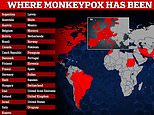
The UK has logged 302 infections, the most out of any other country, followed by Spain (190), Portugal (143), Canada (80) and Germany (66)
Health chiefs have warned monkeypox, a virus endemic in parts of Africa and is known for its rare and unusual rashes, bumps and lesions, could also spread to some pets and become endemic in Europe. Undated handout file image issued by the UK Health Security Agency of the stages of Monkeypox
Epidemiologists from research institute RTI International in Washington, DC, modelled the monkeypox outbreak in a simulated population of 50million people.
They calculated how the virus would spread if three, 30 or 300 cases were originally brought into a country and no measures were taken to control its transmission.
The team estimated that 18, 118 and 402 people, respectively, would go on to catch monkeypox.
And, depending on the scenario, the outbreak would go on for 23 to 37 weeks.
This suggests monkeypox will continue to spread in the UK, where it was first spotted on May 7, until October 15 2022 to January 21 2022.
Contact tracing cases could drive down transmission by up to 72 per cent and following a vaccinating close contacts would reduce cases by up to 89 per cent.
Following both monkeypox curbs could reduce the duration of the outbreak by 60 to 76 per cent, the researchers found.
Writing in a pre-print published online, the US experts said: ‘Our model results align with prior research on monkeypox outbreaks — whether in endemic or nonendemic countries— that demonstrated the low human-to-human transmissibility of the virus and its comparatively low potential to result in large-scale, heavy-burden outbreaks.’
The researchers noted that a ‘strong public health response’ can ‘substantially reduce’ the number of cases and duration of the outbreak.
They agreed that the global public health risk is ‘moderate’ and the virus should be contained ‘fairly rapidly’.
Teams from the UKHSA are contacting high-risk contacts of confirmed cases and advising them to self-isolate at home for three weeks and avoid contact with children.
Officials said they have linked the outbreak back to ‘gay bars, saunas and the use of dating apps in the UK and abroad’. MailOnline revealed last month that the world’s biggest gay dating app Grindr had alerted to users of monkeypox symptoms.
Both confirmed cases and close contacts in the UK are being offered the Imvanex vaccine to form a buffer of immune people around a confirmed case to limit the spread of the disease.
The strategy, known as ring vaccination, has been used in previous monkeypox outbreaks and is also being carried out in some EU countries.
Monkeypox, first discovered in lab monkeys in the late 1950s, is usually mild but can cause severe illness in some cases.
It can kill up to 10 per cent of people it infects. But the milder strain causing the current outbreak kills one in 100 — similar to when Covid first hit. No monkeypox deaths linked with the ongoing outbreak have yet been reported.
Monkeypox has an incubation period of anywhere up to 21 days, meaning it can take three weeks for symptoms to appear.
Initial symptoms include fever, headache, muscle aches, backache, swollen lymph nodes, chills and exhaustion.
A rash can develop, often beginning on the face, which then spreads to other parts of the body — including the genitals. The rash can look like chickenpox or syphilis, and scabs can form which then fall off.
More than 900 cases have been reported worldwide. Britain has logged 302 infections, the most out of any other country, followed by Spain (190), Portugal (143), Canada (80) and Germany (66).
The UKHSA last week revealed that around six in 10 cases are among gay and bisexual men, while around nine in 10 have been based in the epicentre London.
Most of the country’s infections were among people aged 20 to 49. And 111 cases are known to be men who have sex with men.
Most of the patients caught the virus in the UK rather than abroad, which is significant because previously the tropical disease was confined to a small number of people with travel links to Africa.
The UKHSA has told people to wear condoms during sex for eight weeks after clearing the virus.
They are also been ordered to abstain from sex or close contact with others ‘until their lesions have healed and the scabs have dried off’.