

Analysis: Trump presses on after rough week with his presidential image in shambles
It is still too early to know how Trump’s controversial comments — some alleged and others on tape — will influence voters given that many Americans’ opinions of Trump have hardened and the universe of persuadable voters is shrinking.
As much as Trump tried to shift the conversation to more favorable topics, the week was dominated by coverage of those damning admissions and the continuing fallout over his alleged comments about the military.
Hitting the trail
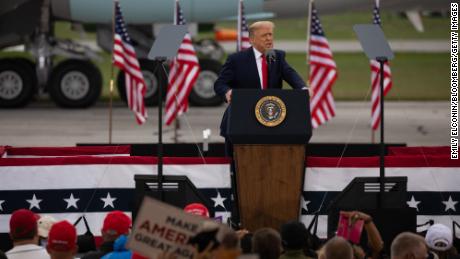
Trump is looking to heighten enthusiasm by hitting the campaign trail, from his rally in Freeland, Michigan, on Thursday — where supporters did not socially distance and few wore masks — to his stops in Minden, Nevada, and Las Vegas this weekend, and Wisconsin next week.

Those moves were a warning sign for Biden because they reflect a narrowing advantage in the Electoral College map, which was Hillary Clinton’s downfall in 2016 even though she won the popular vote.
Though demographics in Nevada, where Trump heads this weekend, have increasingly favored Democrats, and Clinton narrowly won there in 2016, the state is notoriously difficult to poll and the anti-government, frontier ethos of its independent voters aligns well with Trump’s message.
The economic shutdown walloped the state’s economy, which depends heavily on tourism. And the pandemic has hobbled the Democrats’ ability to organize in-person at the state’s casinos, which has often been a central driver of turnout in Clark County where Las Vegas is located.
The US has rounded ‘the final turn’ on the virus?
The night before, at his Michigan rally, Trump again said the country is rounding “the final turn” in the pandemic.
Dr. Anthony Fauci, the nation’s top infectious disease expert, bluntly disagreed with the President’s assertion.
“Look at the data, the data speak for themselves,” Fauci told CNN’s Wolf Blitzer when asked about the President’s claim on “The Situation Room” Friday evening. “You don’t have to listen to any individual. And the data tells us that we’re still getting up to 40,000 new infections a day and 1,000 deaths. That’s what you look at. Look at the science, the evidence and the data and you can make a pretty easy conclusion.”
There has been a decline in new cases in 28 states over the past week and 14 states are holding steady, but Fauci has expressed concern about case surges in several states. On Friday, the Institute of Health Metrics and Evaluation at the University of Washington increased their projections for American deaths by another 5,000, predicting 415,000 deaths by January 1.
“We are still in the middle of this and in order to get any semblance of normality, you’ve got to get that baseline number of infections way down,” Fauci said, adding that he felt “cautiously optimistic” that the US will have a vaccine by the end of this year.
That is, in part, because the coronavirus vaccine may only be 70% to 75% effective and because it will take time to get enough Americans vaccinated to have “an umbrella of immunity.”
Trump isn’t letting that reality color his rhetoric about the virus — or the campaign. While giving those rosy pronouncements about the status of the pandemic at his Thursday rally, he dismissed polls showing him behind Biden, noting that he won some of the states where he was down in the polls during his 2016 race with Clinton.
He said he had just seen a poll showing that he was “up” in Michigan: “I don’t know if that is good or bad,” he said. “Maybe we’re better off being down a little bit.”
“Michigan, you better vote for me,” he added. “I got you so many damn car plants.”
In a preview of his campaign events this weekend, Trump dismissed Woodward, a two-time Pulitzer Prize winning investigative journalist, as a “wack job,” and claimed once again that he was simply trying to keep the nation calm at the beginning of the pandemic — even though he has centered his entire presidential campaign on creating fear about a broad array of real and imagined threats to American life.
That strategy — and Americans’ ability to recognize the incongruence of Trump’s excuses — will be tested at the polls this fall.
After four years of sowing chaos, discord and mistruths, Trump is facing the judgment of voters once again. The revelations of the last week alone would have been disqualifiers for most other candidates seeking the Oval Office, but Trump has made a career of defying the odds. Still, even if voters ultimately give him another shot, the week’s events are yet another indicator that history will not judge him favorably.