

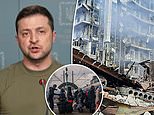
Russia declares ceasefire at 10am local time so civilians can flee encircled city of Mariupol
‘All these people will die because of you’: Zelensky slams NATO’s refusal to establish a no-fly zone over Ukraine and says that it gives Russia the ‘green light’ to carry out more attacks as Kremlin declares limited ceasefire in Mariupol
Volodymyr Zelensky has accused the West of abandoning millions of his people to their deaths Ukraine’s president has lashed out at NATO powers for refusing to impose a no-fly zone over his country NATO says a no-fly zone could provoke widespread war in Europe with nuclear-armed Russia The Kremlin claims to have opened humanitarian corridors around Mariupol and Volnovakha on SaturdayRussia is waging a ‘war of terror’ against civilians after attempts to rapidly capture Ukraine failed
<!–
<!–
<!–<!–
<!–
(function (src, d, tag){
var s = d.createElement(tag), prev = d.getElementsByTagName(tag)[0];
s.src = src;
prev.parentNode.insertBefore(s, prev);
}(“https://www.dailymail.co.uk/static/gunther/1.17.0/async_bundle–.js”, document, “script”));
<!–
DM.loadCSS(“https://www.dailymail.co.uk/static/gunther/gunther-2159/video_bundle–.css”);
<!–
Ukraine’s president Volodymyr Zelensky has accused the West of abandoning millions of his people to their deaths at the hands of Putin’s troops, as Russia increasingly wages a ‘war of terror’ against Ukrainian civilians after attempts to rapidly capture the country failed.
The Kremlin claims to have stopped firing and opened humanitarian corridors to allow civilians to leave the strategic port of Mariupol in the south-east and Volnovakha in the country’s east for five hours between 12pm and 5pm Moscow time.
There was no immediate confirmation from Ukrainian forces, and it is not immediately clear how long the evacuation routes would remain open. If confirmed, the move would be the first breakthrough in allowing civilians to escape the war.
The head of Ukraine’s security council, Oleksiy Danilov, had called on Russia to create humanitarian corridors to allow children, women and the elderly to escape the fighting, calling such corridors ‘question No 1’.
As Russian forces batter strategic locations, Ukraine’s president has lashed out at NATO powers for refusing to impose a no-fly zone over his country, warning that ‘all the people who die from this day forward will also die because of you’.
NATO says a no-fly zone could provoke widespread war in Europe with nuclear-armed Russia. But as the United States and other NATO members send weapons for Kyiv and more than 1million refugees spill through the continent, the conflict is already drawing in countries far beyond Ukraine’s borders.
In a bitter and emotional speech late on Friday, Zelensky criticised NATO over the lack of a no-fly zone, saying it will fully untie Russia’s hands as it escalates its air attack.
‘The alliance has given the green light to the bombing of Ukrainian cities and villages,’ he said, warning that ‘the history of Europe will remember this forever’. In a separate video message to anti-war protesters in several European cities, Zelensky continued to appeal for help. ‘If we fall, you will fall,’ he said.
NATO Secretary-General Jens Stoltenberg had earlier ruled out the possibility of a no-fly zone, saying Western planes would have to shoot down Russian aircraft.
In a warning of a hunger crisis yet to come, the UN World Food Programme says millions of people inside Ukraine, a major global wheat supplier, will need food aid ‘immediately’. The UN Security Council will hold an open meeting Monday on the worsening humanitarian situation. The UN estimates that 12million people in Ukraine and 4million fleeing to neighbouring countries in the coming months will need humanitarian aid.
Ukraine’s leader is set to brief US senators on Saturday on a video conference call as US congress considers a request for $10billion in emergency funding for humanitarian aid and security needs.
While the vast Russian armoured column threatening Ukraine’s capital remained stalled outside Kyiv, Putin’s military has launched hundreds of missiles and artillery attacks on cities and other sites across the country.
Russian forces did not make significant progress on Friday in their offensive to sever Ukraine’s access to the Black Sea and the Sea of Azov, which would deal a severe blow to its economy. There were also no changes in the north and the east, where the Russian offensive has stalled, meeting fierce Ukrainian resistance.
Ukrainian presidential adviser Oleksiy Arestovich said battles involving airstrikes and artillery continued north-west of Kyiv, and the north-eastern cities of Kharkiv and Okhtyrka came under heavy fire. He said Ukrainian forces were still holding the northern city of Chernihiv and the southern city of Mykolaiv.
Ukrainian artillery also defended Ukraine’s biggest port city, Odesa, from repeated attempts by Russian ships, he said.
More than 840 children have been wounded in the war, and 28 have been killed, according to Ukraine’s government. A total of 331 civilians had been confirmed killed but the true number is probably much higher, the UN human rights office said.
The Reuters/IPSOS survey, conducted online and in English throughout the United States on Thursday and Friday, with 831 adults responding, ups the pressure on
Joe Biden has dismissed the notion of no-fly zones because of the risk of open conflict between NATO and Russian forces, despite opinion polling showing that a growing number of Americans want the US to take more aggressive action against the Kremlin.
The White House on Friday said it was weighing cuts to US imports of Russian oil, though it is proceeding cautiously, concerned about a spike in gasoline prices that would add to already high inflation.
On Friday, the United States flew B-52 Stratofortress bombers over NATO’s eastern flank above Romania, exercising with the German and Romanian militaries.
The largest strategic bombers in the US Air Force took off from RAF Fairford, a Royal Air Force station in England, and conducted ‘close air support and integration mission training’, according to a statement from US Air Forces in Europe. The B-52s then flew to Romania, where they conducted more close air support training as part of the Bomber Task Force (BTF) missions.
Ukraine’s president Volodymyr Zelensky has accused the West of abandoning millions of his people to their deaths
A woman reacts as she stands in front of a house burning after being shelled in the city of Irpin, outside Kyiv, on March 4
A Ukrainian soldier was pictured rescuing a tiny baby from a scene of total devastation in Irpin, including what appeared to be a bombed-out bridge, in a harrowing image that summed up the atrocity of the ongoing war
An apartment building damaged following a shelling on the town of Irpin, 26 kilometres west of Kyiv
A school building damaged on March 4, 2022 in Chernihiv in Ukraine, which saw 47 people die, according to local authorities
A man stands in front of a residential building damaged in yesterday’s shelling in the city of Chernihiv on March 4 after 47 people died in the city on March 3, according to officials
Ukrainian troops take cover from Russian shelling in the city of Bucha, located to the west of Kyiv
A B-52 bomber is pictured arriving at RAF Fairford on February 10. On Friday the bombers took off for exercises with Germany and Romania, above Romania
Joe Biden has dismissed the notion of no-fly zones because of the risk of open conflict between NATO and Russia, despite opinion polling showing that a growing number of Americans want the US to take more aggressive action against the Kremlin
The White House announced that US Vice President Kamala Harris will travel to Poland and Romania next week to meet with officials to discuss the Russian invasion of Ukraine and impact the war is having on the region.
Harris’ agenda for the March 9-11 visit to Warsaw and Bucharest is expected to centre on economic, security and humanitarian assistance for Ukraine.
‘The Vice President’s meetings will also focus on how the United States can further support Ukraine’s neighbours as they welcome and care for refugees fleeing violence,’ Harris’ deputy press secretary Sabrina Singh said.
Biden spoke on Friday with Poland’s President Andrzej Duda. Poland is assisting about 700,000 Ukrainians and others who have fled the war so far. The United States has also more than doubled its military presence in Poland, which is a member of NATO, to 9,000 troops in recent weeks.
While the vast Russian armoured column threatening Kyiv remained stalled outside the capital, Putin’s military has launched hundreds of missiles and artillery attacks on cities and other sites across the country.
Russian forces did not make significant progress Friday in their offensive to sever Ukraine’s access to the Black Sea and the Sea of Azov, which would deal a severe blow to its economy. There were also no changes in the north and the east, where the Russian offensive has stalled, meeting fierce Ukrainian resistance.
Invading Russian troops have blockaded the strategic Ukrainian port city Mariupol, its mayor announced Saturday, as Moscow and Kyiv aimed to hold new talks over the weekend.
While laying siege to Mariupol for days, Russian forces also cut its electricity, food, water, heating and transportation in the depths of winter, prompting comparisons to the Nazi blockade of Leningrad in World War II.
Ukraine’s foreign minister Dmytro Kuleba claimed that Russian troops have raped women in cities they have already captured. He did not give evidence to back his claim, but Ukrainian media reported that 11 cases of rape had been reported in Kherson, the only major city captured by Russia after more than a week of fighting.
Earlier, it was revealed that no radiation was released from a Russian attack at Europe’s biggest nuclear power plant in Ukraine.
The International Atomic Energy Agency’s director-general, Rafael Mariano Grossi, said on Friday the building hit by a Russian ‘projectile’ at the Zaporizhzhia plant was ‘not part of the reactor’ but instead a training centre at the plant.
Nuclear officials from Sweden to China said no radiation spikes had been reported, as did Grossi.
Ukrainian officials have said Russian troops took control of the overall site, but the plant’s staff were continuing to ensure its operations. Grossi said the Ukrainians were in control of the reactor.
In the frenzied initial aftermath when the risk of a radiation release was not clear, the attack caused worldwide concern – and evoked memories of the world’s worst nuclear disaster, at Ukraine’s Chernobyl.
Facing worldwide indignation over the attack, Russia sought to deflect blame. Without producing evidence, defence ministry spokesman Igor Konashenkov blamed arson rather than artillery fire.
He claimed a Ukrainian ‘sabotage group’ had occupied the training building at the plant, fired on a Russian patrol and set fire to the building as they left.
There had been conflicting reports earlier over which part of the Zaporizhzhia facility had been affected in the attack, with an official saying at one point that shells fell directly on the facility and set fire to a reactor not in operation as well as a training building. Grossi later said that the fire was in the training centre.
Civilians, mostly women and children rush to board any train car that still has any room on it in Irpin on Friday
A house in Irpin, west of Kyiv, is pictured on fire on Friday as the town came under heavy Russian bombardment
A burnt car stands next to the remains of the local house of culture on Friday, following a night air raid in the village of Byshiv, 20 miles west of Kyiv
The city of Kharkiv, pictured, has been devastated by the Russian invasion. The city, to the east of Ukraine, has been under near constant bombardment
A woman walks amidst the debris of a school building destroyed by shelling, as Russia’s invasion of Ukraine continues, in Zhytomyr on March 4
A local resident walks past the remains of a house of culture following a night air raid in the village of Byshiv, 40 kilometres west of Kyiv
Destroyed Russian armored vehicles in the city of Bucha, west of Kyiv, which has been under heavy attack in recent days
A delusional Putin has again insisted that Russia is not bombing Ukrainian cities, despite fears that 100 people are buried under rubble after an apartment block near Kyiv was struck and after an attack on the city of Chernihiv which killed 49
The confusion itself underscored the dangers of active fighting near a nuclear power plant. It was the second time since the invasion began just over a week ago that concerns about a nuclear accident or a release of radiation materialized, following a battle at Chernobyl.
Grossi said only one reactor of six at Zaporizhzhia is currently operating, at about 60 per cent capacity, and that two people at the site were injured in the fire.
Ukraine’s state nuclear plant operator Enerhoatom said three Ukrainian soldiers were killed and two wounded.
The plant fire came as the Russian military advanced on a strategic city on the Dnieper River near where the facility is located, and gained ground in their bid to cut the country off from the sea.
That move would deal a severe blow to Ukraine’s economy and could worsen an already dire humanitarian situation.
With the invasion in its second week, another round of talks between Russia and Ukraine yielded a tentative agreement to set up safe corridors to evacuate citizens and deliver humanitarian aid to the country, overturned by a war that has sent more than 1million fleeing over the border and countless others sheltering underground.
A handful of cities are without heat and at least one is struggling to get food and water.
In the centre of the capital, Kyiv, frequent shelling could still be heard Friday, although more distant than in recent days, with loud thudding every 10 minutes resonating over the rooftops.
The West has heaped sanctions on Russia, and most of the world lined up to demand Russia withdraw its troops in a vote in the UN General Assembly this week.
In the latest show of international opposition to the invasion, the UN’s top human rights body voted 32-2 on a resolution that would among other things set up a panel of experts to monitor human rights in Ukraine. Only Russia and Eritrea opposed; there were 13 abstentions.
The attack on the nuclear facility led to phone calls between the Ukrainian president and Biden and other world leaders. The US Department of Energy activated its nuclear incident response team as a precaution.
Prime Minister Boris Johnson called for an emergency meeting of the UN Security Council to raise the issue of Russia’s attack on the plant.
In an emotional speech in the middle of the night, Zelensky said he feared an explosion that would be ‘the end for everyone. The end for Europe. The evacuation of Europe’. But most experts saw nothing to indicate an impending disaster.
‘The real threat to Ukrainian lives continues to be the violent invasion and bombing of their country,’ the American Nuclear Society said in a statement.
Putin’s forces have brought their superior firepower to bear over the past few days, launching hundreds of missiles and artillery attacks on cities and other sites around the country and making significant gains in the south.
The Russians announced the capture of the southern city of Kherson, a vital Black Sea port of 280,000, and local Ukrainian officials confirmed the takeover of the government headquarters there, making it the first major city to fall since the invasion began just over a week ago.
A Russian airstrike destroyed a power plant in Okhtyrka, leaving the northeastern city without heat or electricity, the head of the region said on Telegram.
‘We are trying to figure out how to get people out of the city urgently because in a day the apartment buildings will turn into a cold stone trap without water, light or electricity,’ Dmytro Zhyvytskyy said.
Another strategic port, Mariupol on the Azov Sea, was ‘partially under siege,’ and Ukrainian forces are pushing back efforts to surround the city, Ukrainian presidential adviser Oleksiy Arestovich said.
‘The humanitarian situation is tense,’ he told reporters, adding that Ukrainian authorities are in talks with Russian representatives and international organisations to set up humanitarian corridor to evacuate residents and supply food.
Battles in the area have knocked out the city’s electricity, heat and water systems, as well as most phone service, officials said. Food deliveries to the city were also cut.
Video from the port city showed the assault lighting up the darkening sky above deserted streets and medical teams treating civilians, including a 16-year-old boy who could not be saved.
The child was playing football when he was wounded in the shelling, according to his father, who cradled the boy’s head on the trolley and cried.
Ukraine’s defence minister said Friday that the flagship of its navy has been scuttled at the shipyard where it was undergoing repairs in order to keep it from being seized by Russian forces.
Oleksii Reznikov said on Facebook that the commander of the frigate Hetman Sahaidachny decided to flood the ship.
Ukraine’s state emergency agency issued mass text messages on Friday with advice on what to do in case of an explosion: Lie on the ground and cover your head with your hands; use available shelter; do not rush to leave the shelter; help the wounded; do not enter damaged buildings.
Sparks erupt from an administration building (bottom right) as a live steam video shot from a larger office block behind it films Russian tanks opening fire on the Zaporizhzhia nuclear power plant in the early hours of Friday morning
Rafael Mariano Grossi, head of the UN’s nuclear energy watchdog, outlines where the building that caught fire was in relation to the six reactors at Zaporizhzhia
As fears of a nuclear disaster continue, Russian planes also bombed a thermal power plant in Okhtyrka (pictured), 220 miles east of Kyiv, on Friday
Russian armoured vehicles and troops attacked the nuclear power plant in the early hours of Friday, shooting and shelling guards holed up in administrative buildings near the nuclear reactors – setting one of them on fire
Fire-damaged buildings at the Zaporizhzhia nuclear complex are pictured on Friday morning after coming under attack by Russian forces overnight, leading to international condemnation
In the early hours of Friday, the Zaporizhzhia nuclear power plant was attacked. A damaged Russian attack vehicle is seen outside the power plant (left) while firefighters work to extinguish a fire that broke out inside a training complex (right)
Overall, the outnumbered, outgunned Ukrainians have put up stiff resistance, staving off the swift victory that Russia appeared to have expected.
But Russia’s seizure of the Crimean Peninsula in 2014 gives it a logistical advantage now in the country’s south, with shorter supply lines that smoothed the offensive there, said a senior US defence official.
Ukrainian leaders called on the people to defend their homeland by cutting down trees, erecting barricades in the cities and attacking enemy columns from the rear.
In recent days, authorities have issued weapons to civilians and taught them how to make Molotov cocktails.
As the Russian and Ukrainian negotiators met in Belarus on Thursday, Putin warned in a call with Macron that Ukraine must quickly accept the Kremlin’s demand for its ‘demilitarisation’ and declare itself neutral, renouncing its bid to join NATO.
The two sides said they tentatively agreed to allow cease-fires in areas designated safe corridors, and that they would seek to work out the necessary details quickly.
A Zelensky adviser also said a third round of talks will be held early next week.
The Pentagon set up a direct communication link to Russia’s ministry of defence earlier this week to avoid the possibility of a miscalculation sparking conflict between Moscow and Washington.