

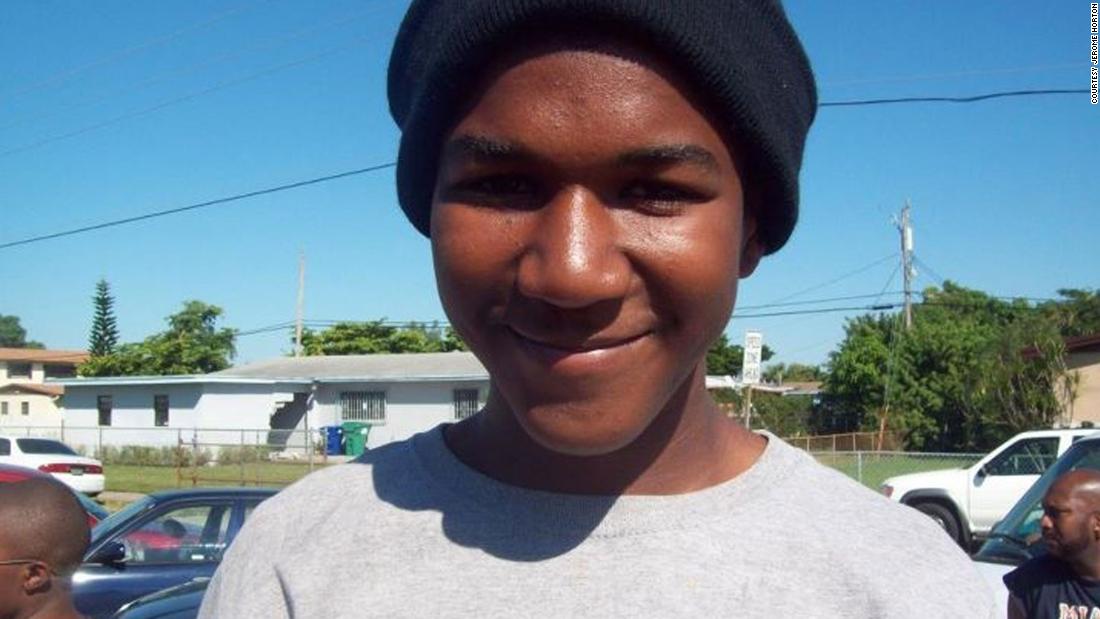
America’s disdain for Black men and boys hasn’t diminished in the years since Trayvon Martin was killed
Police officers’ aggressive handling of a Black teenager in New Jersey wasn’t anomalous — it was part of an age-old pattern of treating Black men and boys as threats to be subdued.
But it’s not only the country’s policing system that fails to recognize the humanity of Black boys. The impulse in the US to treat them not as children but as brutes, as villains, extends far beyond law enforcement.
On the night of the shooting, Zimmerman, who was a neighborhood watch captain in Sanford, Florida, called 911 on Martin. Zimmerman described the teenager using a label that’s long been tagged to Black boys: suspicious. Disregarding police orders not to engage, Zimmerman confronted the teenager. An altercation broke out; Martin was shot dead.
Zimmerman claimed that he acted in self-defense, and he was eventually acquitted. The case illustrated in heartrending fashion a long US history of weaponizing the principle of self-defense against Black men and boys and, more to the point, portraying them as unpredictable aggressors whose every move must be controlled.
A history of dehumanization
To understand this genealogy, let’s rewind to the second half of the 19th century.
The NMAAHC further notes that this fearmongering had horrific repercussions for Black communities, because bolstering stereotypes of Black men as “animalistic and brutish gave legal authority to White mobs and militias who tortured and killed Black men for the safety of the public.”
It’s worth emphasizing that these anti-Black narratives and their effects weren’t limited to the American South; as the NMAAHC says, “headlines of newspapers across the nation, beginning around the turn of the century, document a frenzy of arrests, attempted lynchings and murders of ‘Black brutes’ accused of insulting or assaulting White women.”
While many of these sensationalist news stories focused on Black men, Black boys weren’t spared from dehumanizing stereotypes, either.
No matter that there was never any evidence to support these theories; the important thing was to plant the idea, water it with fear and watch the animosity grow.
History is filled with examples of the sometimes lethal consequences that racist perceptions have for Black boys. Maybe the most infamous example occurred in 1955.
An all-White jury acquitted the two men not even a month after Till’s swollen and mangled body was retrieved from the river.
Till’s story exemplifies a wider truth: Black boys are often viewed differently than their White peers simply because of their race.
Put more bluntly, Black boys aren’t seen as children at all — instead, they’re a menace.
The cycle continues
Though history offers egregious examples, you don’t have to comb through bygone decades to observe the disdain that many Americans have for Black men and boys. You can just look at recent headlines.
Perhaps coincidentally, the verdict was released almost two years ago to the day — February 23, 2020 — on which Travis McMichael, Gregory McMichael and their neighbor William “Roddie” Bryan followed Arbery through the streets of a Georgia neighborhood and gunned him down.
Prosecutor Christopher J. Perras said during closing arguments on Monday that Arbery’s killers saw “a Black man in their neighborhood and assumed the worst of him.”
“This wasn’t about trespassing. This wasn’t about neighborhood crimes, either. It was about race — racial assumptions, racial resentment and racial anger,” Perras said.
“What she was doing was pulling a page from the age-old textbook on anti-Black violence,” Caroline Light, a senior lecturer at Harvard University, where her research focuses largely on histories of citizenship and belonging, told CNN. “That has a very long history in this nation — the criminalization of Black men and boys as somehow being less than human.”
Light also drew parallels between the McMichaels and Bryan trial and the Zimmerman trial.
“If you look at George Zimmerman’s case, the defense did everything it could to smear Trayvon Martin, to make him appear as some terrifying villain rather than a child. And that (practice) is formulaic.”
Of course, the two trials ended in dramatically different ways, at least in part because of the role that video of Arbery’s murder played in advancing justice.
“What’s true now, that was never true before, is that a White family sitting in their home can have to watch with their own eyes,” writer Wesley Lowery, who covered the unrest that occurred in Ferguson, Missouri, after a White policeman fatally shot Black 18-year-old Michael Brown in August 2014, told CNN’s Laura Jarrett. “(Video) forces a level of empathy that has otherwise never existed between Black and White America.”
Former US Attorney General Eric Holder echoed some of Lowery’s sentiments.
“The jury is actually witnessing what happened,” Holder told Jarrett. “Video helps the prosecution a great deal.”
Yet 10 years after Martin’s death, it’s hard to say that the US is in a fundamentally better place when it comes to the treatment of Black men and boys, even with the recent conviction of Arbery’s killers of hate crimes.
“The fact that we still see this (dehumanization of Blackness) is, I think, proof that we’ve not really come that far,” Light said. “I wish that I had a silver lining. But I think that we’re going to continue to see these kinds of narratives play out because they’re so effective, ultimately (at reinforcing existing power structures).”