

Queen’s moving tribute to Prince Philip was most watched Christmas Day TV
Queen’s moving tribute to her late husband was most watched Christmas Day TV with more than 9MILLION viewers tuning in to poignant broadcast referencing the loss of her ‘beloved Philip’
Queen’s speech, broadcast on BBC and ITV, was watched by 9.1million viewersStrictly Come Dancing’s Christmas special claimed the next highest viewershipWon by Anne-Marie, 5.8million people tuned in to watch the BBC’s dance show
<!–
<!–
<!–<!–
<!–
(function (src, d, tag){
var s = d.createElement(tag), prev = d.getElementsByTagName(tag)[0];
s.src = src;
prev.parentNode.insertBefore(s, prev);
}(“https://www.dailymail.co.uk/static/gunther/1.17.0/async_bundle–.js”, document, “script”));
<!–
DM.loadCSS(“https://www.dailymail.co.uk/static/gunther/gunther-2159/video_bundle–.css”);
<!–
The Queen‘s Speech was the most watched programme on Christmas Day, beating out Strictly Come Dancing and Call the Midwife.
Some 7.4million viewers on the BBC and 1.7million viewers on ITV tuned in as the Queen delivered her first Christmas speech since the death of Prince Philip in April this year.
The broadcast, which was around 10 minutes long and was one of the most emotional speeches the monarch has ever given, saw her reflect on the events of the year including the loss of her husband and the continuing impact of the coronavirus pandemic.
In the poignant speech, the monarch said there was ‘one familiar laugh missing’ during the festive season this year.
Strictly Come Dancing’s Christmas special also proved a ratings hit, claiming the most viewers outside of the royal festive message.
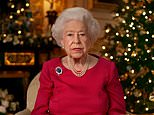
The Queen paid an emotional tribute to her late husband Prince Philip in her Christmas message this year, while sitting beside a framed picture of the royal couple (pictured)
Wearing the sapphire brooch she donned on her honeymoon in 1947 and again for her diamond wedding anniversary, the 95-year-old head of state also reached out to families who have lost loved one this year and addressed the Covid crisis.
The Queen sat behind a desk adorned with a solitary photograph of the Queen and the duke in 2007 to mark their 60th wedding anniversary as she spoke to the nation from the White Drawing Room in Windsor Castle.
She also spoke fondly of her eldest son Charles and his wife Camilla, and also of William and Kate, for their climate activism. Just a tacit mention was made to Lilibet Diana, Harry and Meghan’s daughter, as one of four great-grandchildren born this year.
But there was no reference – either on screen or by name during the nine-minute broadcast – to Andrew, Harry or Meghan, the trio having stepped back from royal duties as the House of Windsor faces its most severe crisis since arguably the 1990s.
The Strictly special, which was won by pop star Anne-Marie, was watched by an average of 5.8 million viewers, according to overnight figures from the BBC.
The 30-year-old singer and her professional dance partner Graziano Di Prima were victorious after performing a thrilling cha cha, which earned them a perfect score of 40 from the judges.
In total, 5.8million viewers tuned in to watch the Strictly Come Dancing Christmas special
BBC One secured eight of the top 10 programmes on Christmas Day – with ITV taking eighth and ninth place with episodes of Coronation Street and Emmerdale.
Third place went to Call The Midwife with 4.7 million viewers, Michael McIntyre’s Christmas Wheel secured 4.6 million and was fourth, while Blankety Blank took fifth with 4.2 million.
Sixth place was taken by Mary Poppins Returns, the 2018 sequel to the well-loved 1964 film, with 3.7 million viewers, while animated production Superworm was in seventh with 3.34 million.
On ITV, Coronation Street secured 3.25 million viewers and Emmerdale was watched by 3 million.
In 10th place, the festive EastEnders special had an audience of 2.9 million.
BBC One sitcom Mrs Brown’s Boys, which usually secures high audience numbers, did not feature in the top 10.
The Christmas Special of Call the Midwife grabbed third spot with a total of 4.7million viewers
Charlotte Moore, the BBC’s chief content officer, said: ‘Viewers chose the BBC on Christmas Day and entertained them in their millions, with Strictly taking the top spot.
‘Nothing brings the country together at Christmas quite like the BBC, there was something for everyone with the seven most popular programmes across the day that caps off a brilliant year on the BBC, celebrating British creativity where we have delivered hits and award winning work and seen huge audiences come to our shows.
‘It’s these moments, in a time of intense competition, that prove that after 99 years the BBC matters more than ever.
‘We have an ambitious and exciting year ahead in 2022 to mark our centenary year with an unmissable range of world class content that will celebrate and reflect the unique role the BBC continues to play in the lives of audiences across the UK.’
From a radio address in 1952 to slick, modern day TV production: How The Queen’s Speech has changed over the years
The Queen’s Christmas Message is a staple of British Christmas tradition.
The monarch marks the festive season every year with a televised address to her subjects on Christmas Day at 3pm on the dot.
The tradition began in 1932 when King George V, Queen Victoria’s grandfather, used the radio to address his subjects.
He was convinced to do so by the founder of the BBC, Sir John Reith, who believed that an address by the Sovereign to inaugurate the Empire Service (which became the BBC World Service) would give it a kickstart.
Radio was still a relatively new medium at the time and the King had been initially skeptical about the suitability of an address but quickly grew to love the chance to talk to his subjects.
The first address was delivered live across the British Empire using General Post Offices who received the transmission from British shortwave transmitters.
The traditional time of 3pm for the broadcast was chosen to be at that time to allow as many people across the Empire to tune in.
King George’s address was the first time that many of his subjects had that level of access to the Sovereign.
Addresses became firm favourites of Britons throughout World War Two as George V’s younger son, King George VI, used radio addresses to rouse the morale of war-weary nation.
1952: Months after the death of her father, King George VI, a 26-year-old Queen Elizabeth took on the daunting task of delivering the Christmas speech from Sandringham, pictured
When the 26-year-old Queen ascended to the throne in 1952, she used her first broadcast to thank the people of Britain for their support and asked them to pray for her ahead of her Coronation the following year.
Dressed in a classic suit, the Queen took her seat behind a desk at Sandringham, Norfolk, where equipment had been set up to record her message for radio.
It came months after the premature death of her father and marked the most important address of the young monarch’s life since a radio speech on her 21st birthday in 1947 from South Africa.
She used the speech to also extend greetings to British servicepeople serving abroad.
1957: The Queen made the decision to broadcast the Christmas message on both television and radio for the first time in 1957, following on from the television broadcast of her coronation in 1953 which was orchestrated by the Duke of Edinburgh
The first televised Christmas Message came in 1957 as the Queen followed on from her coronation in royal events that were broadcast on television.
She used the broadcast to showcase pictures of her children, the young Prince Charles and Princess Anne on the desk at Sandringham.
It was one of the few times that the broadcast was delivered lines and the producer for the address later said that the Queen was a natural with a teleprompter.
1967: Ten years after the first televised broadcast in 1957, the Queen’s Christmas speech was seen in colour for the first time
Some 10 years later the Queen’s Christmas broadcast was shown in colour for the first time.
She said: ‘Modern communications make it possible for me to talk to you in your homes and to wish you a merry Christmas and a very happy New Year.
These techniques of radio and television are modern, but the Christmas message is timeless.’
The speech was recorded in Buckingham Palace, although the framed photos that now draw so much interest and symbolism were not included in the set-up as they were in 1957.
In her speech, the Queen paid tribute to Canada on the centenary of its Confederation.
1971: The Queen with sons Prince Andrew, then 11, and Prince Edward, then seven, looking at a family photograph album, as she delivered a Christmas message focused on families
The Queen focussed on family in her 1971 speech, as she invited her youngest children, Prince Andrew and Prince Edward, to browse through a photobook with her.
The speech was focussed on the theme of family and marked one of the only times that the broadcast had involved other royals.
The occassion marked a rare outing for the young princes as the Royal Family tend to remain largely private until they come of age.
1975: The Queen wrapped up as she headed into the gardens of Buckingham Palace for her first outdoor broadcast in 1975
Breaking from the norm, the 1975 speech was broadcast from the gardens of Buckingham Palace, marking the first time it was recorded outdoors.
The Queen wrapped up in a heavy coat to stay warm on the chilly and grey winter’s day.
It was a year of record inflation and unemployment in the UK under prime minister Harold Wilson. and worldwide, to which The Queen referred.
She said: ‘We are horrified by brutal and senseless violence, and above all the whole fabric of our lives is threatened by inflation, the frightening sickness of the world today.
‘Then Christmas comes, and once again we are reminded that people matter, and it is our relationship with one another that is most important.’
2006: In a break from the royal residences, the Queen filmed her message from Southwark Cathedral, where she met children working on a nativity collage
In another break with tradition, the 2006 Christmas Message was filmed at Southwark Cathedral
It marked only the second time the speech was filmed outside of a royal residence.
The Queen donned a vibrant green skirt suit as she met children working on a nativity collage at the cathedral.
In her speech, the monarch thanked the public for the ‘very generous response’ to her 80th birthday.
She also met children who were working on a nativity collage as part of the break from royal residences.
1997: The Queen’s address in 1997 was overshadowed by the death of Diana, Princess of Wales, in August of that year, an event she acknowledged at the outset of her festive speech
The Queen’s address in 1997 was overshadowed by the death of Diana, Princess of Wales, in August of that year.
The months after Diana’s death saw intense criticism of the Sovereign who was pressured into a public showing of sorrow at the events.
After doing so, the Queen again acknowledged her sorrow at Diana’s passing by quoting a William Blake poem about the intertwining of joy and sorrow.
She also remarked that the year was not just sad as the monarch and Prince Philip celebrated their Golden Wedding anniversary.
2002: The Queen used her 2002 speech to reflect on the death of her mother, Queen Elizabeth, and sister Princess Margaret while also marking the end of her Golden Jubilee year
The Queen’s sorrow was also a theme in the 2002 Christmas Message five years later.
The year had seen the passing of the Queen’s mother, the Queen Mother, and her only sister Princess Margaret.
Much like 1997, the Queen had also celebrated in the year of her Golden Jubilee.
In the speech, she expressed her sympathies for those who had also lost loved ones over the year and commented on the festivities over the Jubilee summer.
2017: The Queen used her speech to welcome another new member to the family: Prince Harry’s then new fiancee, Meghan. The actress’ photo was seen left, out of this frame
The Queen used the 60th anniversary of her first broadcast in 2017 to welcome a new member of the Royal Family.
The Queen welcomed Prince Harry’s then new fiancee, Meghan by featuring a framed photo of the couple from their engagement shoot was on display alongside other family pictures.
The annual address was produced by Sky News and was recorded in the palace’s 1844 room which is decorated with a large tree and features family photos.
2020: The Queen’s role as a figure for national unity became even more important – showcased in the high viewing figures for her speech in 2020 at the height of the second wave of Covid infections
The Queen’s role as a figure for national unity became even more important during the pandemic.
While still shielding from Covid at Sandringham in Norfolk, the Queen paid tribute to the sacrifices that young people had made to protect the old during the pandemic.
She spoke of the indomitable spirit of the British people and how they rose to the challenges that Covid posed.
This came in a year where the Queen made an extraordinary public address to the nation during the height of the pandemic’s first wave.
The monarch was widely praised for the leadership she showed when she drew upon the words of Dame Vera Lynn to rouse the isolated nations: ‘We’ll meet again’.
The speech was the most-watched television event of the Christmas period, indicating that a Covid-weary Britain was looking to the head of state for strength.