

100-year-old census papers go online showing how our ancestors lived and worked in the wake of WWI
Masks, fuel crisis and a rising temperatures… sound familiar? 1921 census papers published today give glimpse of life 100 years ago when UK was in grips of Spanish flu pandemic, miners strikes and a heatwave
Sneak peek of 100-year-old records, taken on June 19 1921, will be shown on a family history website Under the 1920 Census Act, the 1921 census can’t be published online until more than 100 years have passed They have information about nearly 38 million people in England and Wales
<!–
<!–
<!–<!–
<!–
(function (src, d, tag){
var s = d.createElement(tag), prev = d.getElementsByTagName(tag)[0];
s.src = src;
prev.parentNode.insertBefore(s, prev);
}(“https://www.dailymail.co.uk/static/gunther/1.17.0/async_bundle–.js”, document, “script”));
<!–
DM.loadCSS(“https://www.dailymail.co.uk/static/gunther/gunther-2159/video_bundle–.css”);
<!–
A country traumatised by a deadly pandemic, a fuel crisis, unrest in Northern Ireland and a blistering summer heatwave…
It’s an apt summary of 2021, but also comes eerily close to also describing the state of Britain 100 years ago – as the nation recovered from the Spanish flu pandemic, battled a coal miners’ strike, and endured temperatures of more than 90F.
Britons will be reminded of how our ancestors lived and worked in the wake of WWI as an early preview of the 1921 census papers is set to be released today.
A sneak peek of the 100-year-old records, which were taken on June 19 1921, will be shown on the family history website Findmypast and hold information about nearly 38 million people who lived in England and Wales.
Under the 1920 Census Act, the 1921 census can’t be published online until more than a hundred years have passed.
A sneak peek of 1921 census (pictured) have been released ahead of January publication showing how our ancestors lived and worked in the wake of WWI and the Spanish flu pandemic
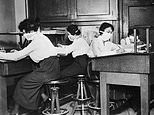
Similarities: Young women are pictured wearing masks to guard against influenza, which killed 20 million people between 1918 and 1920
Buses and train services were cancelled and postponed as a result of the impact of Spanish flu. Pictured left: A bus being disinfected in London in 1920. Right: A London Underground train being cleaned amid the coronavirus pandemic in May 2020
British Prime Minister David Lloyd George (1963 – 1945) and French representatives during a Conference at Chequers, the Prime Minister’s residence in Buckinghamshire, February 1921. Left to right: French Prime Minister Aristide Briand (1862 – 1932), Marie Renee Weygand (wife of General Weygand), Lloyd George, General Maxime Weygand (1867 – 1965) and Marshal Ferdinand Foch (1951 – 1929)
Hirohito, the Crown Prince of Japan drives down Fleet Street in London with the Prince of Wales, later King Edward VIII, during his six-month European tour, May 1921
Blackpool Tower, Lancashire, is pictured along with the seafront and beach in 1920. Between 1921 and 1924 all of the steelwork was renewed
More recently: An aerial view shows the Blackpool Tower and the annual illuminations in Blackpool, north west England on September 4, 2021
Kensal Green, circa March 1921: After the First World War, houses were built identically to reduce cost, space and building time. It benefited the growing population and the British economy
Mr and Mrs John Miller and their children attend a GER (Great Eastern Railway) sports day at Romford in east London, July 1921
The records, which were taken on June 19 1921, will be shown on the family history website Findmypast and hold information about nearly 38 million people who lived in England and Wales
The public will able to learn more about how their ancestors as the data hold records on people who lived between two wars, during a period of economic turmoil and when women had just won the right to vote.
The First World War’s impact on society was the biggest to be reflected in the survey, according to Audrey Collins, records specialist in family history at the National Archives.
‘You’ve got the soldiers who came back damaged either physically or mentally. Lots of people died in the flu pandemic, lots of people were disabled by it. There was a big change in the balance of occupations in particular and the balance of the sexes,’ she told the PA news agency.
Genealogy website Findmypast and the National Archives on Wednesday revealed a glimpse into the census findings, which they have spent three years digitising, ahead of next year’s publication.
Apart from people’s birthplaces, names, ages and jobs, the questionnaire also recorded who lived in a home at that particular time, as well as occupants’ relationship to the head of the household – putting their stories in the context of their families and communities.
The 1921 census is more detailed than any previous one taken, as it asked people about their place of work, employer and industry for the first time, as well as whether they were in full-time or part-time education.
Unlike in earlier surveys, respondents could select ‘Divorced’ as an option for marital status.
Mlle. Suzanne Lenglen, of France, the world’s lawn tennis champion, and her partner, American Elizabeth Ryan, in play at Wimbledon, June 1921
The photograph was taken during the mining dispute of 1921, which arose over a question of wage adjustment and hours of working and shows nine hundred trucks of export coal awaiting shipment from the Grimsby Dock coaling station
The Australian team takes the field during the first Ashes Test at Trent Bridge, Nottingham, 28th-30th May 1921. Australia won the match by 10 wickets
Runner Miss Lucas celebrates as she crosses the line in first place at an unspecified athletics meeting in Hendon, London, England, June 1921
The census also asked whether children were orphaned, revealing the impact of the First World War, with 730,000 children recorded with ‘Father dead’ compared with 260,000 with ‘Mother dead’.
‘That will be a really interesting one, where we’ve got potentially blended families with widows or widowers remarrying,’ Ms Collins said.
Aside from households, the census also holds information on people who lived in institutions such as hospitals or prisons, barracks, naval bases and workhouses.
Also included are Royal Navy vessels and RAF units stationed overseas, including in territories newly under British administration following the war, such as Mesopotamia – modern-day Iraq.
From January 6, 2022, anyone will be able to view the census online on Findmypast, allowing them to find out about their ancestors and discover the history of their home or local area.
The public will able to learn more about how their ancestors as the data hold records on people who lived between two wars, during a period of economic turmoil and when women had just won the right to vote (pictured: An insect being removed from the pages of the 1921 Census at the Office for National Statistics)
Under the 1920 Census Act, the 1921 census can’t be published online until more than a hundred years have passed
The 1921 census is more detailed than any previous one taken, as it asked people about their place of work, employer and industry for the first time, as well as whether they were in full-time or part-time education
A man spraying the top of a bus with an disinfectant during the Spanish flu pandemic, which lasted until 1920
The census also asked whether children were orphaned, revealing the impact of the First World War, with 730,000 children recorded with ‘Father dead’ compared with 260,000 with ‘Mother dead’
Two men modelling standard suits at a clothing exhibition, March 1921. The census has been carried out every 10 years since 1801, but two surveys are missing from the national records
The Plough Inn at Stamfordham, Northumberland, May 1921. Under the 1920 Census Act, the 1921 census can’t be published online until more than a hundred years have passed
A ward at Fourth Scottish General Hospital where most patients were influenza cases. The photo was taken in November 1918
During the Spanish flu pandemic, makeshift field hospitals were set up as conventional establishments failed to cope with the deluge of patients. Pictured: Masked doctors and nurses treat flu patients lying on cots and in outdoor tents at a hospital camp, 1918
Ms Collins said: ‘There’s always people who find something they weren’t expecting. Some completely unexpected relative might have been visiting, or some really interesting occupations. Sometimes people find out their granddad was in prison.’
The documents can only be opened to the public next year because under the Census Act of 1920 they must remain secret for 100 years.
The census has been carried out every 10 years since 1801, but two surveys are missing from the national records.
The 1931 survey for England and Wales was completely destroyed in a blaze in 1942 at Hayes, Middlesex, where it was being stored, while the 1941 census was never taken because of the Second World War.
Also included are Royal Navy vessels and RAF units stationed overseas, including in territories newly under British administration following the war, such as Mesopotamia – modern-day Iraq
From January 6, 2022, anyone will be able to view the census online on Findmypast, allowing them to find out about their ancestors and discover the history of their home or local area
In the Spanish flu pandemic, there were no nationwide laws which forced hair salons to close. Images show barbers wearing masks as they continue to cut clients’ hair
That makes the 1921 census all the more valuable for historians, as the next one is not set to be released until 2052.
A team from Findmypast and the National Archives has worked to conserve, transcribe and scan the 1921 census, consisting of more than 30,000 volumes of delicate original documents stored on 1.6 linear kilometres of shelving.
Mary McKee, head of content publishing operations at Findmypast, said: ‘Over the course of the restoration and digitisation process, we have discovered thousands of extraordinary stories from the lives of seemingly ordinary people as well as an abundance of famous figures who helped shaped the world we now live in.
‘This includes literary giants, cultural icons, inventors and innovators, pioneering women, royalty, politicians, campaigners and reformers, forgotten figures and much more.
‘We can’t wait to help people discover their ancestors, uncover the history of their homes or reveal the secrets hidden in these pages when the 100-year rule lifts.’