

Priti Patel sanctions ‘pushback’ tactics to turn migrant boats around
No10 lines up behind Priti Patel’s threats to ‘push back’ migrant boats trying to cross the Channel despite French branding her a ‘clown’ and slating ‘blackmail’ – as admiral jibes that Inspector Clouseau is running border patrols
Priti Patel has sanctioned border force using new ‘pushback’ tactics to stop migrant boats crossing ChannelThe Home Secretary told officials to rewrite law so boats can be turned back despite protests from FranceSome 14,000 migrants are thought to have arrived via the Channel this year amid anger at Paris failure
<!–
<!–
<!–<!–
<!–
(function (src, d, tag){
var s = d.createElement(tag), prev = d.getElementsByTagName(tag)[0];
s.src = src;
prev.parentNode.insertBefore(s, prev);
}(“https://www.dailymail.co.uk/static/gunther/1.17.0/async_bundle–.js”, document, “script”));
<!–
DM.loadCSS(“https://www.dailymail.co.uk/static/gunther/gunther-2159/video_bundle–.css”);
<!–
No10 lined up behind Priti Patel‘s threats to ‘push back’ migrant boats in the Channel today despite French fury at her ‘posturing’ and ‘blackmail’.
Downing Street insisted Britons expected the government to take action after the Home Secretary ordered officials to reinterpret maritime laws so dinghies can be turned around.
The step came amid mounting anger at France’s lacklustre efforts to curb the problems despite being handed millions of pounds by UK taxpayers, with one former admiral jibing that Inspector Clouseau appeared to be running their border patrols.
French politicians waded in branding Ms Patel a ‘clown’, while Interior Minister Gerald Darmanin insisted bluntly: ‘France will not accept any practice that goes against maritime law, and will not accept any financial blackmail.’
Ms Patel also came under fire from experts who said her latest plan is ‘not going to happen’ because overloaded dinghies might sink and France would need to cooperate.
Lucy Moreton, professional officer at the Immigration Services Union, said she would be surprised if the ‘pushback’ tactic is used ‘even once’ because the boats are ‘vulnerable’.
And Tory MP Tim Loughton, a member of the home affairs select committee, said it was ‘not going to happen’ as the vessels would capsize and migrants might drown.
As the wrangling continues over how to tackle the volume of desperate people trying to get to the UK, it has also emerged that Britain has offered use of a plane to help monitor the coast, but was seemingly snubbed. Others have complained that the French are refusing to use drones to monitor when boats are setting off from their coast.
Some 14,000 migrants are now thought to have arrived in Britain via the Channel this year – with demands for Paris to ‘step up to the plate’ and prevent the crossings.
Yesterday saw UK authorities rescue or intercept 301 people with the French reporting they had stopped 302 people reaching Britain, the Home Office said.
The previous day, 456 were rescued by Britain, and 326 by France.
Grilled on the situation at PMQs yesterday Boris Johnson admitted that the government is reliant on the French, but insisted ministers will use ‘every possible tactic’ to ease the problems.
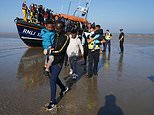
A group of people thought to be migrants are brought ashore from the local lifeboat at Dungeness in Kent, September 7
Priti Patel holding talks with French counterpart Gerald Darmanin last night. She has sanctioned new ‘pushback’ tactics to stop migrant boats in the Channel and turn them back to France amid crunch talks over crossings
A group of people thought to be migrants are brought in to Dover, Kent, aboard a Border Force vessel following a small boat incident in the Channel. Picture date: Wednesday September 8
A group of people thought to be migrants are brought in to Dover, Kent, following a small boat incident in the Channel on September 8
Maritime law dictates that safety must be paramount when operating at sea.
But ministers appear confident that this principle can be interpreted to allow Channel crossings to be turned around in certain circumstances.
Members of Border Force are being given special training to handle migrant boats, but would only deploy the ‘pushback’ tactics when it was deemed practical and safe to do so.
Reports suggested such operations are likely to be restricted to sturdier, bigger migrant boats and only used in ‘very limited circumstances’.
Ms Moreton told BBC Radio 4’s Today programme: ‘In practical terms, if this happens even once, I would be surprised.
‘There are understandably a lot of constraints around it and you cannot do this with a vessel that is in any way vulnerable and more importantly you need the consent of the French to do it.
‘Because when you turn the vessel back toward France, when it is across the median line it has to be intercepted and rescued by the French and it appears the French will simply not engage with this, in which case it’s – if you excuse the pun – dead in the water.’
Mr Loughton, a member of the home affairs select committee, said he supported the principle but it was ‘not going to happen’.
He said: ‘It sounds good. But I’m afraid in practice it’s just not going to happen. These are flimsy boats coming over. Even those that are tougher are completely weighed down.
‘Any boat coming up alongside at speed would capsize most of these boats anyway and then we’re looking at people getting into trouble in the water and drowning … and then we’ll get blamed for that. It sounds good pushing them back but it’s not going to work in practice.’
Lord West, who was first sea lord and chief of the naval staff from 2002 to 2006 and later a security minister under Labour, said the whole policy was ‘highly problematic’.
He told the BBC’s World At One programme: ‘I can understand the Home Secretary and people’s annoyance with what’s going on.
‘I mean, one has to sort of, I have to say rather jokingly, that there must be a sort of Inspector Clouseau running this operation in France that they’ve had all this time and lots of extra people, and in fact the number of people coming across has grown and grown and grown.
‘So I can understand people’s annoyance. But I’m afraid the only way to actually change this is if we get an agreement with France, for example, that if we pick people up to rescue them in the Channel, that we’re allowed to steam back into Calais or Dunkirk, and land them back in France.’
He added that ‘the French at the moment are not being easy about this’, and said: ‘This is highly dangerous. People forget how dangerous the sea is and it’s flat, calm and people have been coming across but it doesn’t take much suddenly for people to go into the water and drown.
‘And when you start playing games about pushing ships back and pushing boats back, that is, as I say, it’s highly problematic. Very, very difficult to do.’
The PM’s spokesman denied that the government was engaging in ‘financial blackmail’, pointing out that ‘significant sums of money’ had been provided to help France tackle the issues.
‘We are content that the tactics that our Border Force staff, our trained Border Force staff, are using are safe and legal,’ the spokesman added.
Pushed on whether there has been a change of policy in how to approach the situation, he said: ‘I think you’re referring to tactical, operational approaches used by Border Force. It’s right that our Border Force has the right range of tactics to address this problem. They… we will make sure it is tested, that (it) is carried out by trained Border Force staff.’
Downing Street said the Government was looking at a ‘range of safe and legal options’ to deal with migrant Channel crossings.
Asked whether the Prime Minister had approved reported plans to turn around boats headed for the UK and send them back to France, the PM’s official spokesman said: ‘Without getting into operational matters, as part of our ongoing response we continue to evaluate and test a range of safe and legal options to find ways of stopping small boats making this dangerous and unnecessary journey.’
He added: ‘I think Border Force have a range of safe and legal options available to them to deploy, I’m not going to comment on operational tactics in more detail.’
He said that the UK’s activities ‘comply with international and domestic law’.
As the temperature rose again, Calais MP Pierre-Henri Dumont, of the opposition Republicans Party, said the UK’s approach was ‘unworthy’.
‘Brexit means leaving the European Union, not leaving the international community,’ he said.
‘By flouting the international law of the sea, by preventing migrants from applying for asylum, by taking the risk of drowning, the United Kingdom is de facto breaking the rules commonly accepted by all [EU] member countries.
‘I call on the British government to come to its senses and fundamentally change its domestic law and its labour market – which encourage illegal immigration – before trying to trample on international law.’
A senior member of President Emmanuel Macron’s LREM party, who asked not to be named, said Ms Patel was ‘increasingly seen as a clown in France’.
He said: ‘Madame Patel doesn’t know what she’s talking about. She just seems to grab at mad and dangerous ideas without displaying any knowledge of the law or international diplomacy.’
Ms Patel and Mr Darmanin, held discussions on crossings at Lancaster House in London, in the wake of hundreds of migrants being brought ashore in Kent over the past few days.
Government sources said the pair had a ‘constructive’ meeting in which Ms Patel made clear tackling the number of people making their way from France to the UK on small boats was her ‘number one priority’.
But the French Government said the turnaround tactics would have ‘a negative impact on our co-operation’.
Migrants in Kent after making the journey yesterday amid a growing row between Priti Patel and France over the crossings
Pictured: A graph showing the number of migrants crossing the Channel on small boats since 2019. The figure has increased each year
In a letter sent on Monday before the meeting, Mr Darmanin rejected a UK request to set up a joint command centre in northern France, with police and border force officers from both countries patrolling the coastline and the Channel.
He said he had ‘taken note’ of the offer of a British plane to monitor the coastline, but suggested it would be up to the EU’s Frontex border agency.
And on the issue of ‘pushback’ tactics, the letter said: ‘The French position on intervention at sea remains unchanged. Safeguarding human lives at sea takes priority over considerations of nationality, status and migratory policy, out of strict respect for the international maritime law governing search and rescue at sea.
‘With regard to traffic and conditions for crossing the Channel, France has no other solution than to intervene most often on the basis of the provisions in international law governing search and rescue at sea (SAR). The use of maritime refoulements to French territorial waters would risk having a negative impact on our cooperation.’
Health minister Helen Whately insisted this morning that the focus was still on discouraging migrants from attempting the journey, rather than turning them back en route.
Asked repeatedly whether the Government was looking push boats back to France, she said: ‘The Government looks at all the options, but a really important thing, of course, is you wouldn’t want to put people in any greater danger, they’re taking a dangerous journey as it is, and what we want to do is actually deter them from starting that journey in the first place.’
The row emerged just days after Ms Patel told MPs she is prepared to withhold millions of pounds of cash promised to France to help step up patrols unless an improvement in the number of migrants intercepted by French authorities is seen.
A Government source said: ‘The Home Secretary was clear with the French interior minister that the British public expect to see results.’
According to the Home Office, 785 migrants arrived in the UK on Monday after making the journey from France in small boats, with several young children and a baby among them.
This is the second highest daily total of the year, following the single-day record of 828 people set last month.
The crossings have continued during the better weather conditions this week, with boats arriving at Dover and others being towed on to beaches along the south coast.
Earlier this year, the UK and France announced an agreement to more than double the number of police patrolling French beaches.
It was the second pledge of its kind in a year, in a bid to stop small boats from leaving France.
As part of the deal, the Government pledged to give France £54million to support its efforts to stop small boat crossings.
Charities urged the Home Office to take a ‘more humane and responsible approach’ towards asylum seekers and said humanitarian visas were needed to help ‘prevent the chaos of the Channel crossings’.