

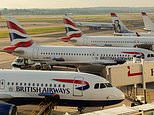
BA to axe short-haul Gatwick flights and replace them with services from a subsidiary airline
British Airways to axe short-haul flights from Gatwick PERMANENTLY – but replace them with services from a new as-yet-unnamed subsidiary airline
BA has 47 short-haul routes and 1,881 flights at Gatwick but operations have been on hold since Spring 2020BA said to staff that the move would help the firm stay ‘agile and competitive’ and build ‘sustainable’ presenceThey said they are planning a new subsidiary to run alongside its existing long-haul Gatwick operation Travel site believes the most likely solution for BA will be to launch a new subsidiary ‘along the lines of its City Flyer operation at London City’
In an email to staff, British Airways today announced that it is to axe its short-haul operation at Gatwick and replace it with an entirely new operation by a subsidiary airline.
BA has a schedule of 47 short-haul routes and 1,881 flights from Gatwick, according to travel data and analytics firm Cirium, but its short-haul operations from the hub have been on hold since Spring 2020 due to the pandemic.
If BA pulls out of short-haul at the airport, four destinations will no longer have any service to it – Algiers, Cologne/Bonn, Genoa and Manchester.
The travel journalist and broadcaster, Simon Calder, who began his career in aviation at Gatwick airport cleaning the offices of BA in the 1970s, told MailOnline the firm may be going back to a model of ‘older planes and less well-paid staff’ with its new subsidiary.
He added that passengers using the new airline will not get the ‘bottle of water and snack’ in economy class, nor will flyers enjoy the ‘world’s most generous cabin baggage policy’ any longer.
In an email to staff, British Airways announced that it is to axe its short-haul operation at Gatwick and replace it with an entirely new operation by a subsidiary airline
The largest destination by flights is Jersey, followed by Malaga in Spain and Faro in Portugal, said Cirium.
BA’s email said that the move would help it stay ‘agile and competitive’, but admitted that staff would need to wait for concrete plans to emerge.
According to travel site headforpoints.com, it read: ‘As you know, we haven’t been operating short-haul flights at Gatwick during the pandemic.
‘This was previously a highly competitive market, but for us to run a sustainable airline in the current environment, we need a competitive operating model.
‘Because of that, we are proposing a new operating subsidiary to run alongside our existing long-haul Gatwick operation, to serve short-haul routes to/from Gatwick from summer 2022.
‘This will help us to be both agile and competitive, allowing us to build a sustainable short-haul presence at Gatwick over time.
‘As of today, we don’t have the answers, but we want to be upfront about the complexity we’re dealing with, and working through with your trade union representatives. We will keep you posted as things develop.’
A map showing British Airways’ routes -both long and short-haul – out of Gatwick
BA has a schedule of 47 short-haul routes and 1,881 flights from Gatwick, but its short-haul operations from the hub have been on hold since Spring 2020 due to the pandemic
Headforpoints.com explains that the replacement airline could be from the stable of BA’s parent company – IAG – such as Vueling or Level, but suggests that’s not likely.
Vueling, it says, ‘is not a particularly well-known brand outside of its Iberian footprint’ and therefore ‘there would [be] little benefit in introducing the brand to UK travellers versus creating a fresh new one’.
Level, meanwhile, ‘only operates from Barcelona’, with IAG ‘extremely reluctant, so far, to introduce the airline at its own hub-fortresses of Heathrow or Madrid’.
The site believes the most likely solution for BA will be to launch a new subsidiary ‘along the lines of its City Flyer operation at London City’.
It adds: ‘This would be operationally distinct, operated under a distinct brand with separate pilot and crew agreements.’
Rhys Jones of headforpoints.com told MailOnline Travel: ‘Gatwick has always been second-best for British Airways and it appears that it is now looking to drive its costs down even further as it competes with easyJet, Ryanair and Wizz Air, which are increasingly dominating the airport.
‘By recruiting a separate crew on new poorer contracts, British Airways will be able to better compete with the low-cost carriers although it’s not clear what effect this could have on service. It is also debatable whether a race to the bottom is one that BA can win. British Airways has recently re-introduced free snacks and water in economy on short-haul flights from Heathrow, but this could be at risk.
‘It’s not clear whether the new airline will fly under the British Airways brand – which risks damaging it – or if British Airways will introduce a new brand that the public won’t recognise. The choice it makes will have an impact on what we can expect in price and service.’
MailOnline Travel has approached British Airways for comment.