

Covid-19 UK: Number of alerts sent by NHS Covid app plunged by 43% last week
Is pingdemic mayhem finally easing? Number of alerts sent by NHS Covid app plunged by 43% last week… and that was BEFORE software was tweaked
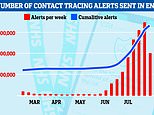
- NHS Covid app alerts fell from 690,129 to 395,971 on the week ending July 28
- The app was updated earlier this week to ensure fewer contacts are pinged
- Fall in alerts was before tweak suggesting it could be down to people deleting it
The number of alerts given out by the NHS Covid app fell by 43 per cent in a week before it was made less sensitive, official data has shown.
NHS figures show 395,971 alerts in England and Wales were sent in the seven days up to July 28, down from 690,129 the week before, in a sign that pingdemic mayhem may finally be easing.
Thousands of people have deleted the app in recent week to avoid the alerts, which tell people they have been in close contact with someone who had tested positive for coronavirus.
The alerts have forced millions into self-isolation across the country — despite not testing positive themselves — leading to chaos as supermarket shelves were left barren with workers having to stay home.
Earlier this week it was announced that the app is being updated so fewer contacts will be instructed to isolate.
Dr Mike Tildesley, a member of the Scientific Pandemic Influenza Modelling group (Spi-M) advising ministers, insisted the app is still ‘incredibly useful’, despite the swathes of people being asked to isolate.
But the changes were made after the latest data — suggesting another reason is behind the drastic fall in alerts.
Britain’s Covid cases began falling on July 21 but did not reach the rate of the drop off in alerts until July 28, the last date included in the most recent data.
It comes after academics claimed Britain’s Covid self-isolation sentence could be halved to just five days and be as effective.
Data suggests 98 per cent of transmission occurs either before people become ill, or within five days of symptoms starting.

NHS figures show 395,971 alerts in England and Wales were sent in the seven days up to July 28, down from 690,129 the week before

The number of alerts given out by the NHS Covid app fell by 43 per cent in a week before it was made less sensitive, official data has shown
The NHS data today showed the number of venue check ins made with the Covid app dropped from 6.6million to 2.3million in the most recent week — a drop-off of 65 per cent.
People are no longer required to use the app to check into venues since restrictions were lifted on July 19, but the trend gives an indication in the fall in usage.

Mike Tildesley, a member of the Scientific Pandemic Influenza Modelling group (Spi-M) advising ministers, described the app as ‘incredibly useful’, despite large numbers of people being asked to isolate
Earlier this week, Health and Social Care Secretary Sajid Javid said the ‘logic’ behind the app was tweaked, although the sensitivity and risk threshold will remain unchanged.
Instead of checking contacts for five days before a positive test, the app will only go back two days.
Dr Tildesley told Sky News: ‘I know there have been some challenges in terms of particularly at the moment the so-called “pingdemic”, but in terms of being able to detect contact, it has been extremely valuable.
‘Obviously the challenge with that is that a lot of people are going into isolation and over the last few days the app has been made less sensitive.’
Dr Tildesley said there is a worry that if too many people are pinged, fewer may be willing to comply, but he added that the tweak will ‘hopefully guarantee higher levels of compliance’.
Fresh data from Oxford University’s Pathogen Dynamics Group shows up to 40 per cent of transmission occurs before symptoms emerge.
But most of this happens during the two days before people fall ill, which prompted the alteration of how the NHS Covid app works.

Oxford University data suggests 98 per cent of transmission occurs either before people become ill, or within five days of symptoms starting
Around 35 per cent of transmission occurs within the first two days of people having symptoms.
However, the data came from September — before the highly-infectious Delta variant took off.
Ministers are keen to replace quarantine rules with daily testing, with scientists now investigating if it is safe to make the drastic move.
Dr Muge Cevik, an infectious disease expert at the University of St Andrews, told the Telegraph: ‘Given most transmission happens very early on, the isolation period could be much shorter for the cases.
‘Viral load peaks pretty quickly, so people are highly infectious within the first few days.
‘Also importantly, many people have non-specific mild symptoms before developing more noticeable ones, like fatigue or myalgia, so that’s probably when people are highly infectious too but continue daily activity.
‘So, the current self-isolation guidelines, especially given the lack of support provided for sick leave, does not serve for the purpose.’